What is Web EDI and Why Use It?

Key Takeaways:
- Web EDI is a more affordable solution used to make smaller suppliers EDI capable through a browser-based portal.
- For customers, it means seamless EDI to ERP integration, lower costs, and full supply chain automation.
- For suppliers, it means easy EDI access, streamlined orders, faster document exchange, and real-time updates.
- Enable your smallest suppliers and explore Cleo’s web EDI portal today.
In this blog, we cover:
Traditional EDI (Electronic Data Interchange) is fantastic for automating business document exchange. However, it requires a certain level of technical infrastructure that smaller suppliers might not have the systems or resources to support.
This creates a disconnect.
Automating EDI communication (or EDI order process)with every supplier is critical for supply chain efficiency, but many smaller suppliers are stuck with manual processes (like email, fax, phone, etc.).
What is Web EDI?
Simply put, web EDI is exchanging EDI or electronic data interchange (EDI) documents using web forms, all within an internet browser. Effectively turning tedious paper documents or technical EDI files into easy-to-use, online forms.
Users simply fill in the fields, and the system automatically converts this information into an EDI message. This message is then sent securely using standard internet protocols like FTPS, HTTPS, or AS2.
Web EDI Setup
Setting up Web EDI is simple, making it easy for all your business partners to participate. This is especially helpful when working with international partners who might have limited IT or EDI experience, as companies don't need to install any special software or manage complex EDI systems.
At its core, Web EDI empowers small and medium-sized businesses to create, receive, manage, and respond to electronic documents right from their browser. These forms often come with pre-filled information and built-in business rules, ensuring compliance with your partners' requirements. Essentially, businesses worldwide can connect without needing dedicated IT staff for their EDI setup.
Web EDI typically follows a "hub and spoke" model. In this setup, the larger business acts as the hub, while its smaller partners are the spokes. The hub organization implements EDI and provides these web forms for its smaller partners. These forms can be hosted on the hub's own website or by an EDI network service provider. Partners then use their web browsers to exchange documents as forms, which are seamlessly converted into EDI documents behind the scenes for the hub to process.
How Web EDI Works
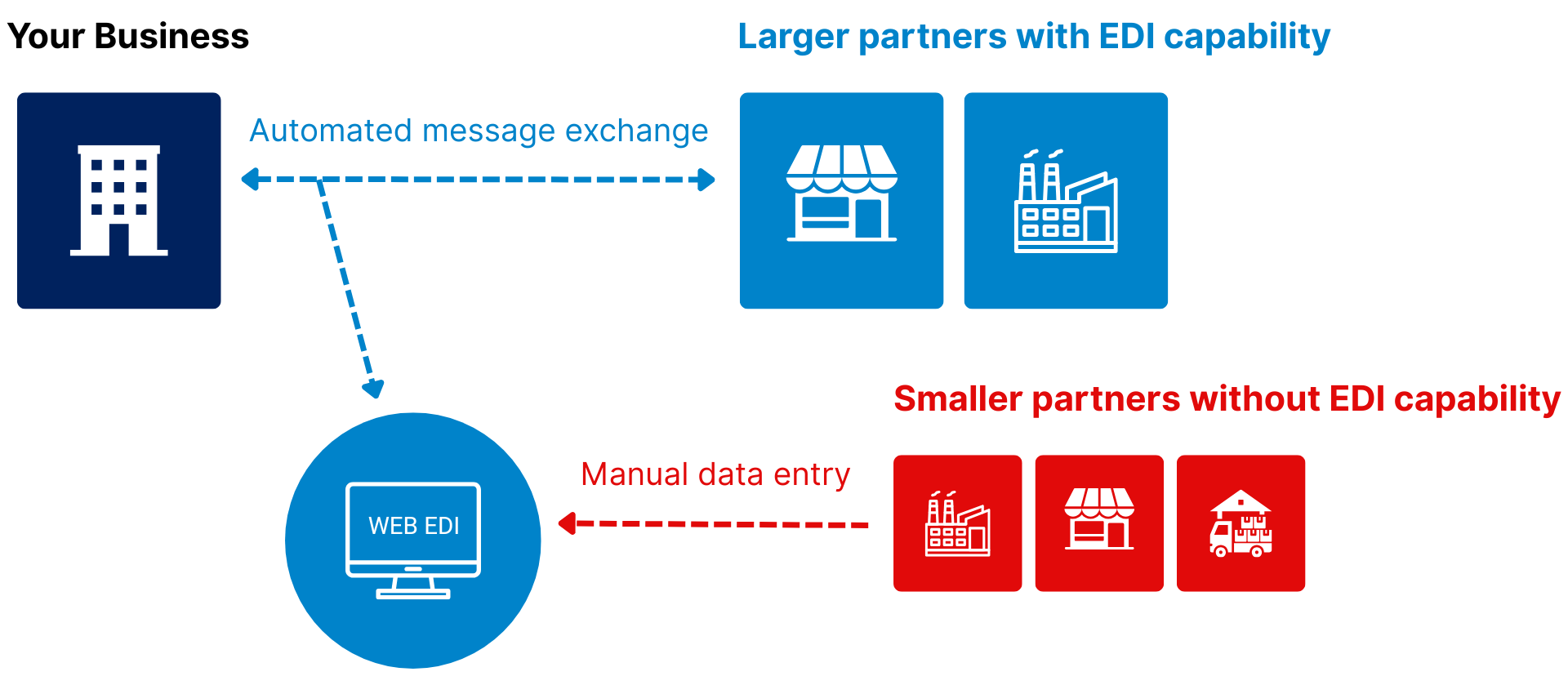
For the central organization (you), your web EDI solution should typically integrate with existing back-office systems like your enterprise resource planning (ERP) system. Because a web EDI solution is accessible through a web-browser, this makes it easy to extend the solution to other suppliers in your network.
Once your smaller trading partners access the portal, EDI messages can be manually punched and sent directly from their web-browser to be received and processed from the same solution on your end.
Key benefits of extending your web EDI solution to your suppliers include:
- Unified B2B Messaging: All B2B messages flow automatically. Incoming messages land directly in your ERP, and outgoing messages are sent directly from it.
- Minimal Overhead: Assuming your EDI provider handles updates and monitoring, you'll see little to no extra work. Data flows autonomously.
- Enhanced Integration: Web EDI extends your ERP, automating all B2B interactions with suppliers.
This ensures the efficiency of large-scale EDI deployments extends to your entire supplier network without draining your resources.
From Your Supplier's Viewpoint (The Spoke)
From your supplier's viewpoint, the web EDI portal functions as a highly intuitive, cloud-based EDI solution that streamlines their electronic communication with you through an internet portal.
When a supplier is brought onto the system, they first receive secure login credentials to their tailored web EDI portal. This isn't a generic platform; it's often branded and customized to match the customer's business, creating a familiar environment for their partners.
Within this portal, administrative settings allow for granular control over access rights, meaning different users at the supplier's company (like sales, shipping, or accounting personnel) can have specific permissions relevant to their roles. Crucially, alerts can be configured, including email notifications for new incoming documents, critical updates, or even overdue responses, ensuring no vital communication is missed.
Incoming Messages
When you (their customer) sends an EDI message, such as a purchase order, a forecast, or a request for quotation, the supplier immediately receives an email alert. This alert typically includes a brief summary and a direct link to the new message within the portal.
The power of web EDI for the supplier lies in its ability to abstract away EDI complexity. The raw, structured EDI message (like an X12 850 for a Purchase Order) is automatically converted by the portal into a visually clear, human-readable format. This usually looks like a traditional purchase order form, but displayed on a web page.
Suppliers can then review the details of the message in their browser, with all critical fields clearly presented. For record-keeping, they can typically download the document as a PDF, allowing them to easily integrate it into their internal filing systems, print it, or share it with other departments without needing specialized EDI software. This significantly simplifies their internal document management.
Sending Outgoing Messages
When the supplier needs to send a message back, such as an order response, an advance ship notice (ASN), or an invoice, they navigate to the relevant section of the portal. They are presented with a simple, web-based form with clearly labeled fields. No prior EDI knowledge is needed; they simply enter the required information and click "send" or "submit."
The portal then takes over, converting the human-entered data into the precise, structured EDI file (like an X12 855 for a Purchase Order Acknowledgement or an X12 810 for an Invoice) that the customer expects. This EDI message is then securely transmitted directly to the customer's ERP system.
A significant efficiency enhancer in advanced systems is the semi-automatic pre-population of outgoing messages through a process often called a "PO flip." This means the portal can automatically pull relevant data from an incoming document to fill out an outgoing one. For instance, when a supplier responds to a purchase order, the portal might automatically populate fields like item numbers, quantities, pricing, and due dates from the original PO.
This drastically reduces the need for manual re-entry, with the supplier simply confirming or making minor adjustments, such as acknowledging quantities or confirming ship dates.
Order Management
In the most robust web EDI systems, there's a continuous, real-time synchronization between the customer's ERP system and the web EDI platform. This critical feature ensures that any changes the customer makes to an order in their ERP are immediately reflected in the supplier's portal.
If an order is amended (e.g., quantities changed, delivery dates adjusted, or items added/removed), the supplier is instantly notified via the portal or an email alert. Highly advanced systems may even automatically merge individual order changes. For example, if an initial order for 500 custom-machined bolts is later amended to 400 bolts and 100 specialized washers, the portal presents a consolidated, updated view of the original order, reflecting all changes seamlessly.
This eliminates confusion and the need for suppliers to manually reconcile multiple document versions. This combination of real-time data integrity and automated processing not only reduces potential order discrepancies for the customer but also substantially enhances operational ease and accuracy for its supplier network, fostering more robust and responsive supply chain interactions.
Benefits of Web EDI
There are a number of benefits for both for you and your suppliers when you implement a web EDI solution.
Benefits For You (the Customer):
On your side (the customer), web EDI helps deliver full supply chain automation by saving time and costs while seamlessly integrating EDI with your ERP to reduce strain on internal teams.
1. Full Supply Chain Automation
Web EDI lets you automate communication with all your suppliers, not just the large ones already using EDI. Smaller partners are brought into the same digital workflows, eliminating manual tasks like emails, phone calls, and spreadsheet updates.
2. Time and Cost Savings
By automating routine exchanges—such as purchase orders, confirmations, and invoices—you reduce the errors and inefficiencies that come with manual processing. This saves time, cuts costs, and makes your operations more scalable.
3. Reduced Strain on Internal Teams
Your teams no longer need to chase documents, fix mistakes, or manually input supplier data. Instead, they can focus on more strategic, high-value work.
4. Seamless ERP Integration
Every message flows directly into your ERP, just like traditional EDI. And with Cleo, you also benefit from 24/7 monitoring, automatic updates, and real-time visibility into your supply chain data.
Benefits of Web EDI for Your Suppliers:
For your suppliers, web EDI provides an easy-to-use EDI portal that simplifies document exchange, speeds up responses, and gives real-time visibility into purchase orders and updates.
1. Simple, Accessible Trading
Suppliers without their own EDI infrastructure can easily log in to a web portal, view your messages, and respond—without needing technical knowledge or expensive software.
2. Faster, Smarter Document Creation
The portal often pre-fills information (through features like PO flips) so suppliers only need to review and approve documents before sending them back.
3. Real-Time Visibility
Suppliers can see up-to-date purchase orders and changes instantly, minimizing confusion and reducing the need for back-and-forth communication.
Why Web EDI?
Optimizing your supply chain demands a clear understanding of your supplier ecosystem, which comprises both large, established partners and a multitude of smaller entities.
Your larger suppliers typically possess established traditional EDI infrastructure. Integrating with these partners requires standard message guide exchanges, mapping completion, and routing configuration. This is a direct operational process.
Conversely, your smaller suppliers generally lack in-house EDI capabilities. For this segment, automated message exchange is contingent upon your provision of a web EDI portal. While individual smaller entities may appear minor, this "long tail" collectively represents a significant portion of your supplier network. Historically, managing communications with this group consumes substantial internal resources, impacting efficiency and accuracy.
Therefore, implement an EDI strategy that mandates total automation across your entire supply chain. As web EDI offers the sole viable solution for automated, structured document exchange with partners lacking inherent EDI capabilities, its integration is not merely beneficial—it is a critical imperative for a robust and successful EDI framework.
Cleo's Web EDI Solution
Cleo’s cloud-based web EDI and eCommerce solution, offers a fast, affordable way to achieve EDI compliance with any retailer, grocer, manufacturer, or trading partner.
Designed for ease of use, Cleo's Fulfillment Portal simplifies order fulfillment by streamlining and automating processes through a multichannel, all-in-one portal. Start using the industry’s leading web-based EDI and eCommerce solution today to enhance efficiency and scalability. With the right web EDI solution, you can seamlessly connect, integrate, automate, and grow your business.
Web EDI is Affordable
- Cleo's web EDI solution has simple, predictable pricing. Only for what you use, with flexible monthly terms and no long-term contracts.
Web EDI is User-Friendly
- Cleo designs web EDI to be easy. Access a simple, web-based portal directly through your browser.
Web EDI Provides Trading Partner Connectivity
- Cleo's web EDI connects you effortlessly to all trading partners and eCommerce marketplaces.
Web EDI Offers Product Catalog & Auto-Pack Features
- Optimize order processing with built-in automation tools.
Web EDI Offers Effortless Document Management
- Easily print UCC-128 labels, packing slips, BOLs, invoices, and other shipping documents.
Web EDI Enables Batch Processing
- Handle ASNs, invoices, and other EDI documents in bulk for greater efficiency.
Web EDI is Scalable
- Connect with shipping services, accounting software like QuickBooks, and various ERP systems.
Seasonal Flexibility:
- Utilize the Seasonal Hibernation feature to pause and resume services as needed.
Learn more about web EDI or Cleo's EDI software, explore more resources in our content hub or simply reach out to our experts for web EDI related questions today.
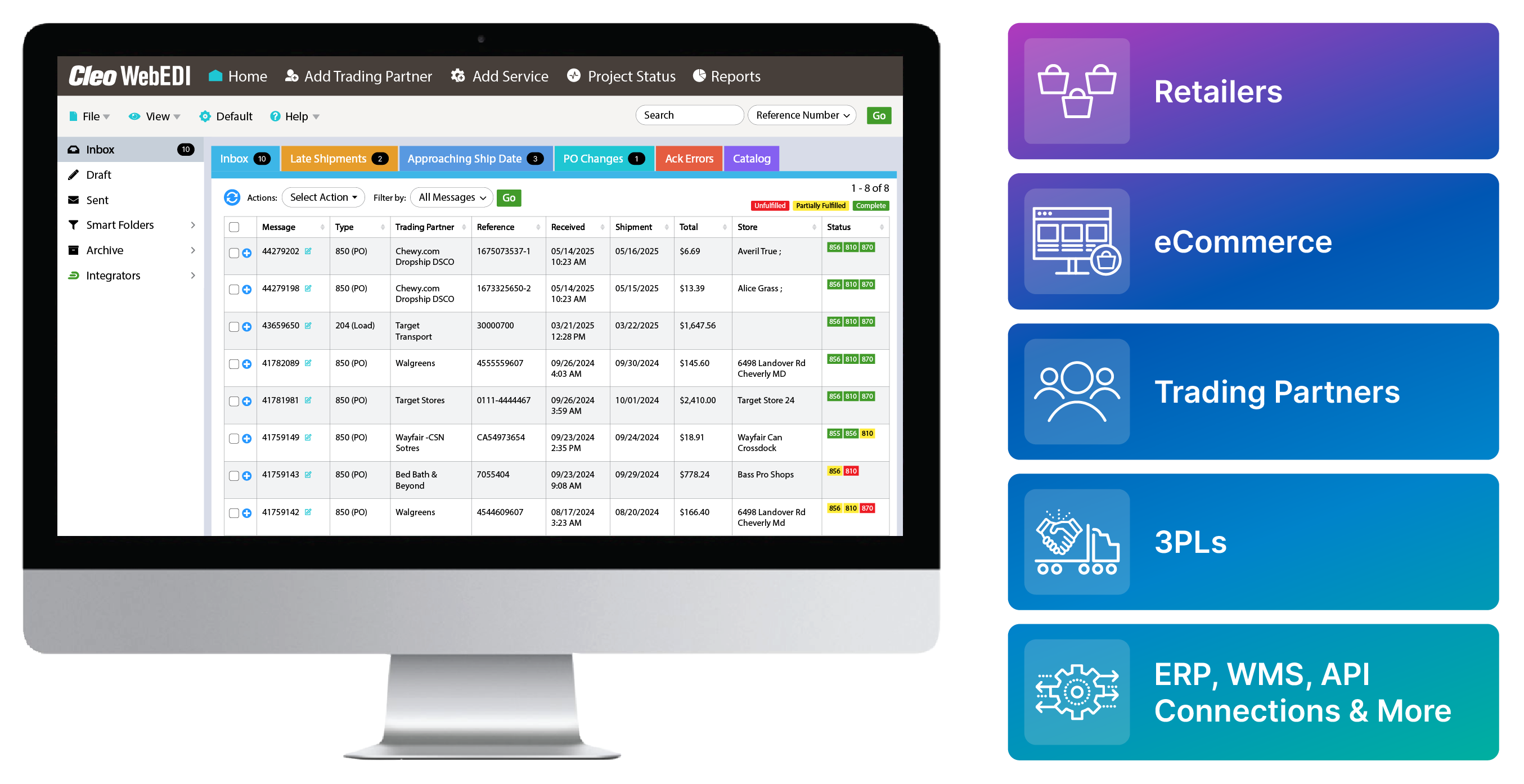
Cloud-Based Web EDI
A simple and affordable way to become EDI capable and compliant within minutes to any trading partner.


