What is EDI? Complete Guide to Electronic Data Interchange

Aaron Keeports
The growing majority of businesses (60-86%) involved in the EDI order process are continuing to utilize EDI transactions. For those wondering exactly what EDI is, let's cover the topic completely.
- What is EDI?
- What is an EDI System?
- Step-by-Step EDI Workflow
- Benefits of EDI
- Challenges of EDI Solutions
- What Does EDI Implementation Require?
- End-to-end connection using EDI Integration
- The Future of EDI in Smart Supply Chains
- Harness the Power of EDI with Cleo Integration Cloud
What is EDI?
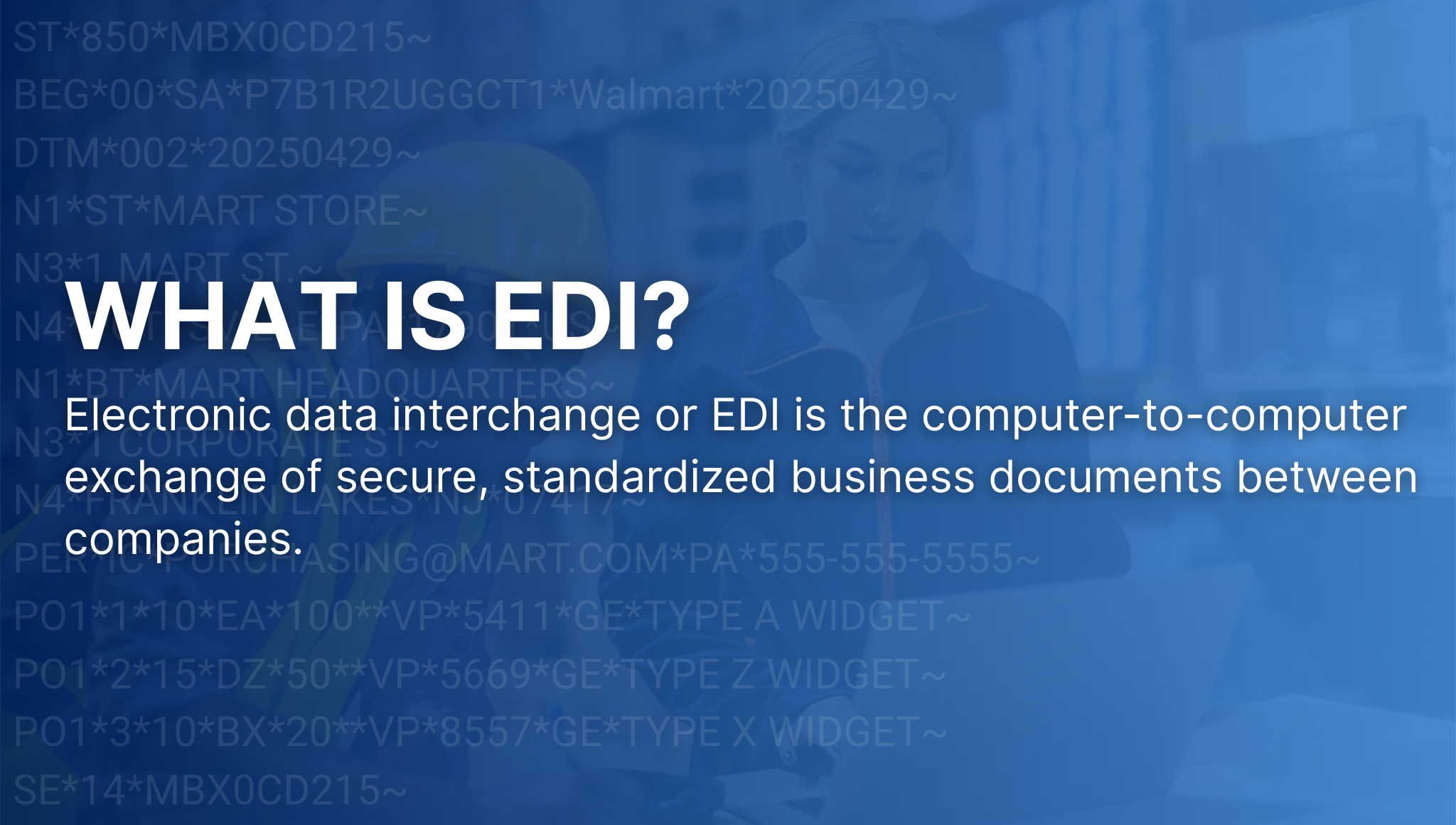
EDI, or Electronic Data Interchange, is the computer-to-computer exchange of business information in a standardized format between EDI trading partners in the form of electronic documents. EDI automates the exchange of business documents like invoices, purchase orders, and shipping forms between organizations. Instead of relying on manual data entry from paper-based or emailed documents, cloud EDI enables digital systems to seamlessly share and process information, reducing errors and improving efficiency across business networks.
Now, wherever EDI data is used, that EDI data needs to be integrated. EDI integration is the process that makes EDI data compatible with a business's internal systems, like an ERP, order management system or inventory management software.
Read more about EDI Order Processing
Business Processes Without EDI
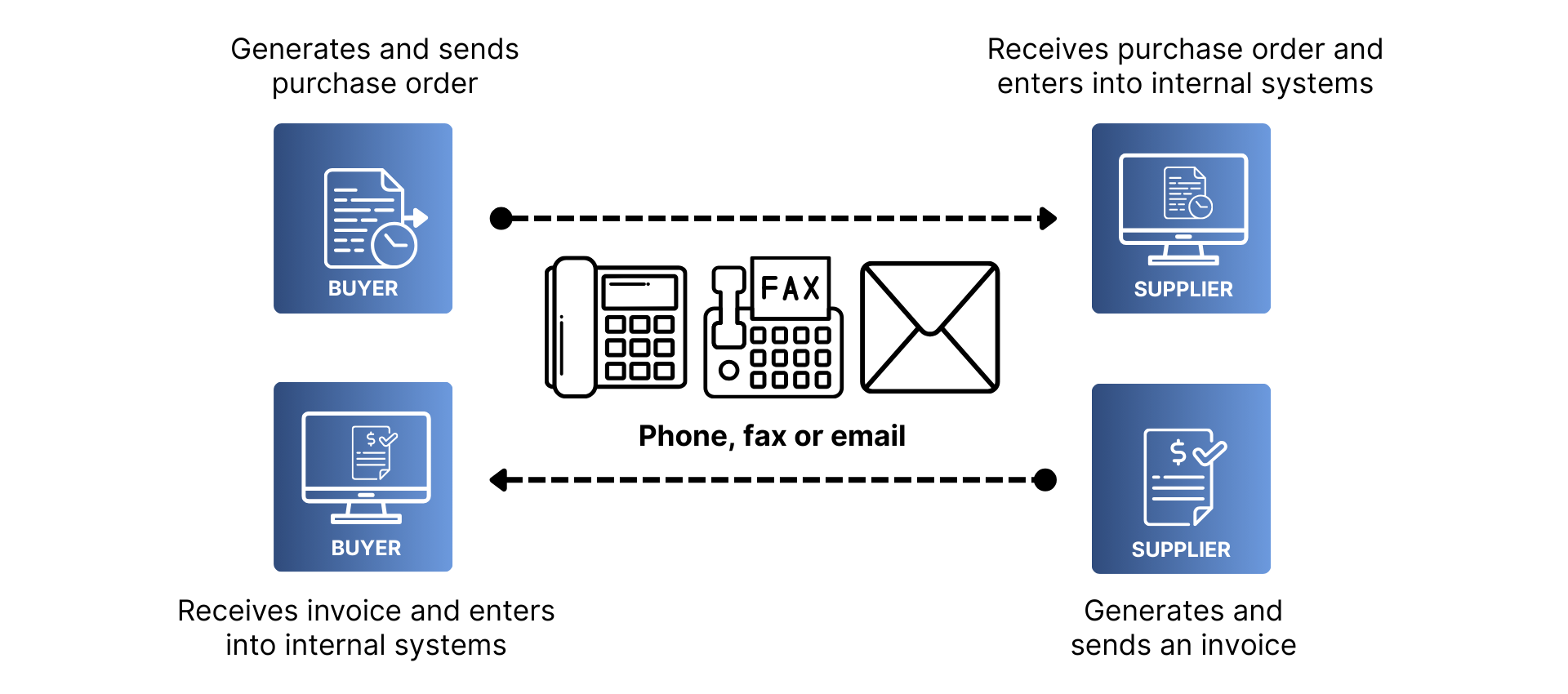
When operating without EDI, the purchase order to invoice flow is a series of manual, paper-centric steps. It typically involves the buyer creating a physical or electronic document (the PO), sending it manually via mail, fax, or email. The supplier then receives this manual or semi-electronic document and a person must manually enter the details into their order entry system. After processing the order and shipping the goods, the supplier creates a physical or electronic invoice and sends it manually to the buyer. A person in the buyer's accounts payable department must then manually receive, enter, and match the invoice against the original PO and receiving documents. This often necessitates time-consuming manual investigation and communication to resolve any discrepancies before payment can be processed.
Business Processes With EDI
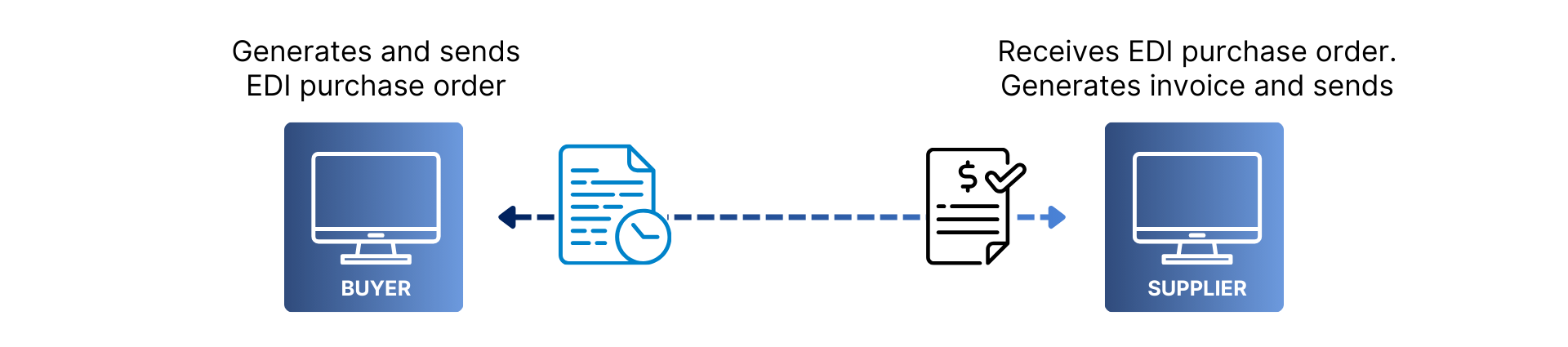
In contrast, EDI establishes a direct computer-to-computer exchange of business documents in a standardized, machine-readable format. When a buyer uses EDI, their system generates a purchase order, which is automatically translated by their EDI software into a standard EDI document (like an EDI 850) and transmitted electronically over a secure network directly to the supplier's EDI system. The supplier's EDI system automatically receives, translates, and loads the PO data directly into their order management system without any manual data entry by a person. Similarly, when the supplier ships goods and creates an invoice, their system generates the invoice data, which is automatically translated into an EDI document (like an EDI 810) and sent electronically to the buyer's EDI system. The buyer's system receives, translates, and automatically loads the invoice data into their accounts payable system, enabling automated matching against the original PO and receiving information, often automating approval and payment processes as well.
What is an EDI System?
An EDI system is made up of several essential parts integrated together, that automate the EDI exchange process. At Cleo, these are all delivered through a single solution included with superior services.
If you’re still stitching together translators, networks, and support on your own, you’re exposing your business to risk, inefficiency, and non-compliance. An effective EDI system must deliver these four core components.
1. EDI Translator
Your EDI translator is the linchpin of your system. It must convert internal business documents into standardized EDI formats (ANSI X12, EDIFACT, etc.) and back again with zero data loss or formatting errors. More importantly, it must do so flexibly, adapting to each trading partner’s specific syntax and structural nuances—because no two partners implement EDI exactly the same way.
If your translator can’t handle variations without constant manual intervention, it’s a liability.
2. EDI Mapping Tables
EDI mappings are your data governance strategy in action. They define the precise translation between your system’s fields and your partner’s EDI requirements. Done right, mapping eliminates data discrepancies, prevents chargebacks, and ensures that mission-critical documents—like POs, ASNs, and invoices—flow automatically and flawlessly. These mappings tell the translator exactly where to locate and place each data point in your system—ensuring the right information reaches the correct destination every time.
This is where most DIY EDI systems fail. With hundreds of trading partners, manual mapping maintenance is unsustainable.
3. Secure Transaction Network
EDI requires more than fast file transfers—it demands secure, traceable, and compliant communication channels. Whether you’re using AS2, SFTP, OFTP, or a managed VAN, your network must guarantee delivery, encrypt data end-to-end, and provide full audit trails.
If your communication layer lacks visibility or reliability, you’re flying blind—and risking SLA breaches.
4. Support and Maintenance Services
EDI is constantly evolving. Trading partner specs change. Compliance requirements tighten. Standards are updated. If your system isn’t proactively monitored and maintained, it will break—quietly, and usually at the worst possible time.
This is why top-performing companies choose a managed EDI provider. With continuous updates, real-time error detection, and expert support, you don’t just keep up—you stay ahead.
If your EDI system doesn’t deliver all four of these components, integrated and managed by a single vendor, you’re not running EDI—you’re running a patchwork. And in today’s supply chain environment, that’s not just inefficient—it’s dangerous.
Beyond the four core components of an EDI system—translator, mapping, secure network, and support—businesses seeking full automation and scalability should also implement tight integration with internal systems like ERP or WMS, enabling real-time document processing without manual input. Real-time dashboards and analytics provide visibility into transaction performance and errors, while automated exception handling ensures continuity when issues arise. Compliance tools such as audit logs, access controls, and regulatory support (e.g., HIPAA, SOX) are essential for risk management. Efficient partner onboarding capabilities accelerate growth and adaptability, while cloud-based infrastructure ensures high availability, scalability, and resilience. Emerging AI-powered tools can further enhance automation through intelligent document validation and non-EDI partner support. Together, these elements turn EDI from a functional system into a strategic, enterprise-grade platform.
Technical EDI Process Breakdown
The EDI process is the automated creation, convertion, sending, retrieval, and integration of business documents. At a more technical level, the EDI process is essentially a sequence of serialization, segmentation, and protocol-level handshaking.
1. The Mapping Logic (Data Normalization)
Before transmission, data must be flattened. If your ERP uses a relational database, the EDI translator runs a script to map database keys to EDI Elements and Segments.
- Segments: These are the "rows" of EDI (e.g., REF for Reference, DTM for Date/Time).
- Elements: These are the data points within a segment, separated by a Delimiter (usually an asterisk *).
- Segment Terminator: Usually a tilde ~ or a newline, telling the receiving parser where a record ends.
2. Structural Syntax (Enveloping)
Technical validation occurs at three nested levels. If any of these headers are malformed, the parser will reject the entire file:
- ISA/IEA (Interchange): Defines the technical "handshake," including the ISA11 (Repetition Separator) and ISA12 (Standard Version).
- GS/GE (Functional Group): Segregates data by type. For example, a PO group for Purchase Orders or IN for Invoices.
- ST/SE (Transaction Set): The core payload. It includes a Control Number (ST02) which must match the ending SE segment to ensure no data was truncated during transit.
3. Transport Layer Mechanics
Modern EDI rarely uses plain FTP. The technical standard is AS2 (Applicability Statement 2):
- S/MIME Wrapping: The EDI document is wrapped in an S/MIME envelope.
- Encryption/Hashing: The payload is encrypted using the receiver's Public Key and signed with the sender's Private Key (SHA-2 or higher).
- MDN (Message Disposition Notification): This is the critical technical "hook." Upon receipt, the receiver’s server calculates a checksum (MIC) and sends it back. If the sender's MIC matches the receiver's MIC, the transaction is technically "non-repudiated."
4. Parsing and Inbound Processing
Upon arrival at the receiver's gateway:
- De-enveloping: The system strips the ISA, GS, and ST headers.
- Compliance Check: The translator checks the data against the EDI Guideline (MIG). If a mandatory element is missing (e.g., an N1 segment for Name), the parser throws a Syntax Error.
- Acknowledgement Generation: The system automatically generates a 997 (Functional Acknowledgment). This is not a business "Acceptance" of the order, but a technical confirmation that the EDI syntax was valid and the data was successfully handed off to the internal application.
Let's look at a Standard Purchase Order (850) transaction between a Retailer (Sender) and a Supplier (Receiver).
1. Data Generation (The ERP Trigger)
A buyer at the Retailer creates a Purchase Order in their Oracle or SAP environment. The system generates an internal IDoc or JSON file containing raw data:
- SKU: 99283-A
- Qty: 500
- Price: $12.50
- Ship-to: Warehouse 04
2. Translation & Segmentation (The X12 Build)
The Retailer's EDI translator picks up this raw file and converts it into a string of X12 850 segments. This is where the technical "flattening" happens:
ST*850*0001~
BEG*00*SA*PO12345**20260407~
PO1*1*500*EA*12.50**VC*99283-A~
N1*ST*WAREHOUSE 04~
CTT*1~
SE*5*0001~
- PO1 Segment: Technically identifies the line item, quantity (500), and price (12.50).
- CTT Segment: A technical hash total (Transaction Totals) used by the receiver’s parser to verify the number of line items matches what was sent.
3. The AS2 Handshake (The "Pipe")
The Retailer’s server connects to the Supplier’s IP address via AS2.
- Encryption: The file is encrypted using the Supplier’s Public Key.
- Transmission: The Retailer sends the encrypted packet over HTTPS.
- Technical Receipt (MDN): The Supplier’s server sends back a Message Disposition Notification. This MDN contains a mathematical string (the MIC) proving the Supplier received the exact bits the Retailer sent.
4. Logic Validation (The Receiver's Parser)
The Supplier’s translator receives the file. It doesn't just "open" it; it runs a technical Syntax Check:
- It verifies the ISA Control Number hasn't been used before (to prevent duplicate orders).
- It ensures the SE*5 (Segment Count) matches the actual number of segments in the file.
- The 997: If the syntax is perfect, the Supplier’s system automatically transmits a 997 Functional Acknowledgment back to the Retailer.
5. Inbound Integration
Finally, the "cleansed" data is mapped into the Supplier’s database. The SKU 99283-A is matched against the Supplier's internal product table, and a "Sales Order" is automatically generated in their system without a single human typing a key.
Step-by-Step EDI Workflow
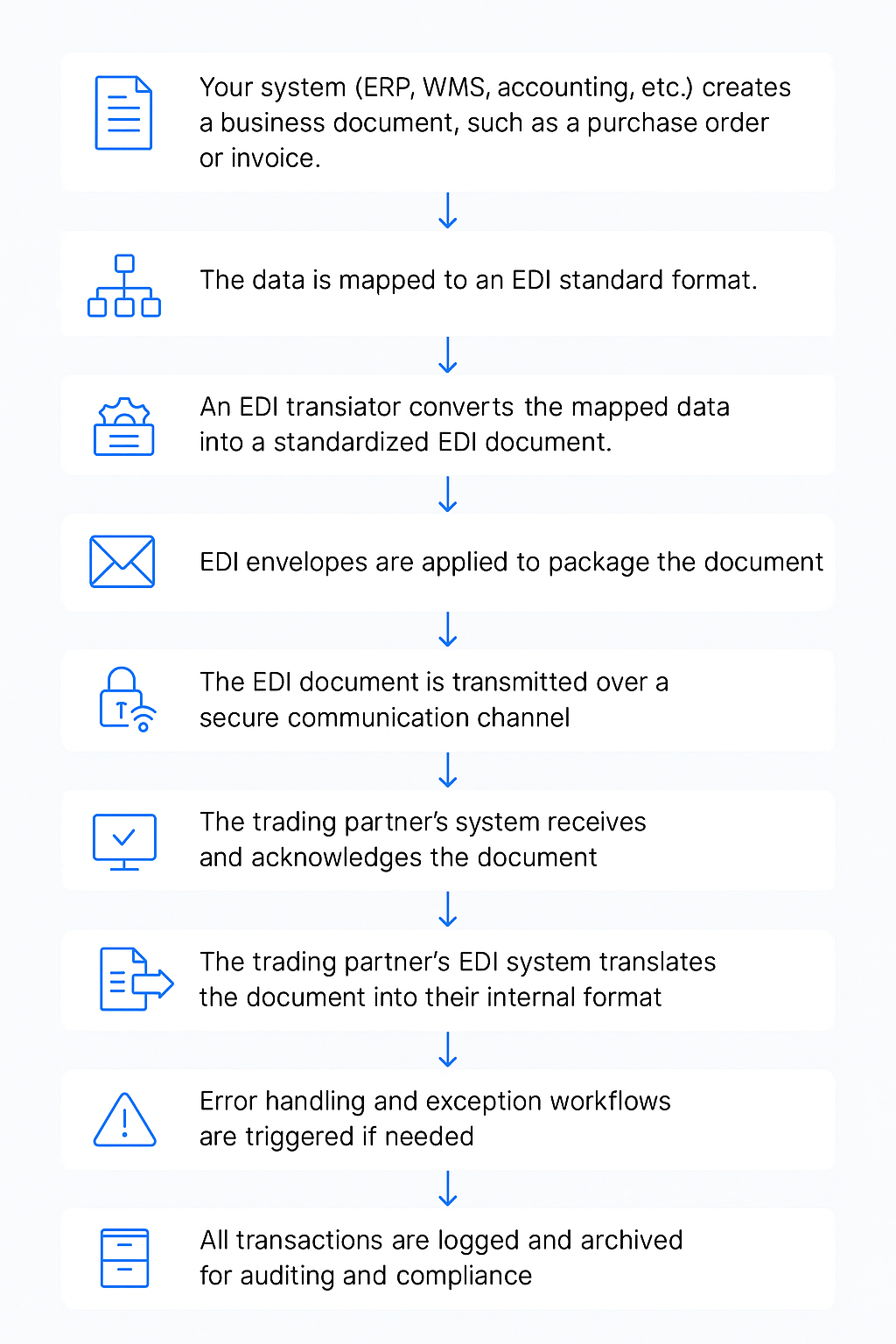
Here is a step-by-step explanation fo a typical EDI workflow:
Your business system (could be an ERP, WMS, accounting, etc.) generates a purchase order or invoice.
The document is generated based on a business event (e.g., an order being placed) and stored in your internal data format (CSV, XML, JSON, etc.).
The data is mapped to an EDI standard format.
Mapping tables define how each internal field corresponds to EDI segments and elements (e.g., item numbers, quantities, pricing in X12 850 format).
An EDI translator converts the mapped data into a standardized EDI document.
This process transforms the business data into machine-readable EDI syntax, ensuring it meets trading partner-specific formatting rules.
EDI envelopes are applied to package the document.
Envelopes (ISA/GS/ST segments in ANSI X12 or UNB/UNH in EDIFACT) include routing info, control numbers, and identifiers for secure and accurate transmission.
The EDI document is transmitted over a secure communication channel.
Common methods include AS2, SFTP, FTPS, or a Value-Added Network (VAN), ensuring encryption, authentication, and delivery tracking.
The trading partner’s system receives and acknowledges the document.
A functional acknowledgment (e.g., 997 in X12) confirms receipt and basic validation. In AS2 transactions, a Message Disposition Notification (MDN) may also be sent.
The trading partner’s EDI system translates the document into their internal format.
Using their own mapping and translation tools, the EDI file is converted and imported into their ERP or business system for processing.
Error handling and exception workflows are triggered if needed.
Any translation, compliance, or data issues generate alerts and route documents into exception queues for review or correction.
All transactions are logged and archived for auditing and compliance.
The system maintains detailed logs, acknowledgments, and document histories to meet regulatory and business requirements.

EDI Documents
Unique EDI codes are used to specify certain EDI documents, which corresponds to specific EDI transactions. For example, a purchase order might be identified by the code EDI 850, while an invoice could be identified by an EDI 810.
Unlike traditional paper documents or even PDFs though, EDI documents adhere to specific formatting and communication standards to ensure smooth and error-free exchange between different computer systems.
There are a vast number of EDI documents that are sent from one business to another. The types of documents sent depend on the industry, EDI process, EDI standard, and more. Some of the most common EDI documents include purchase orders (EDI 850), invoices (EDI 810), advanced ship notices (EDI 856), and functional acknowledgements (EDI 997).
EDI Standards
EDI document standards play a crucial role in electronic data interchange (EDI). Simply put, these standards, also known as EDI file formats, define the structure and content of business documents like purchase orders, invoices, and order confirmations. Once formatted correctly, these documents are transmitted to trading partners or service providers using established EDI communication protocols.
Think of EDI like sending a package internationally. The EDI standard is like the standardized customs forms that ensure the package contents are clearly defined.
EDI standards are sets of rules and formats that define how business documents should be structured for electronic transmission between trading partners. For example, standards specify if the delivery date should be listed as an integer, decimal, or mm/dd/yyyy. If companies didn’t specify which standard to use, companies and their trading partners would be speaking ‘different languages’ and their internal systems would not be able to understand the data in the EDI documents they receive.
So with everyone "speaking the same language," (i.e. using the same standard) data quality and interpretability are maintained across different systems. Common standards include:
- X12: commonly used in North America, particularly in industries such as retail, manufacturing, healthcare, finance, and transportation.
- EDIFACT: an international standard used primarily in Europe and other parts of the world outside of North America in industries such as transportation, logistics, retail, and international trade
- TRADACOMES: a UK-specific standard commonly used in the United Kingdom in industries such as retail, supply chain management, and manufacturing
- HIPAA: sets standards for the electronic exchange of healthcare information in the United States
EDI Protocols
If EDI standards are the customs forms that outline a package's details, EDI protocols are like the chosen shipping method (plane, boat, train) that dictates how the package is delivered.
EDI protocols define the technical specifications for how data is transmitted between businesses. They determine how the data is packaged, secured, and delivered electronically. EDI data is typically transmitted using secure protocols like SOAP, SFTP, and AS2, which act as secure communication channels to protect your sensitive business information.
Building Richer Communication
EDI software has the capability to merge multiple pieces of data within an EDI document. For instance, it can blend elements like "ITEMQUANTITY" and "ITEMDESCRIPTION" into "ORDERLINE," offering a more detailed depiction of items and their quantities within an order. These combinations create more comprehensive and succinct EDI documents.
Transmission Methods
EDI transmission has two main methods:
- Using a third-party service (EDI VAN): Like a secure mailbox that routes EDI documents between partners. More secure but can be expensive.
- Connecting directly (point-to-point): Partners connect directly over the Internet with secure protocols (like AS2) for a cheaper option.
For example, suppliers send EDI purchase orders directly to retailers' systems (like Walmart, Target, etc.) via point-to-point connections or through a VAN. Additionally, VANs act as intermediaries, facilitating communication between suppliers and multiple retailers. For example, a clothing manufacturer may use a VAN to transmit product catalogs, inventory updates, and shipping notices to various retail partners, ensuring timely delivery and replenishment of merchandise.
EDI Message Standards
Standards like ODETTE, TRADACOMS, GS1, Peppol, and ASC X12 define EDI message formats, ensuring consistency and interoperability.
Take Procter & Gamble (P&G) for example, which implements EDI standards such as GS1. P&G exchanges standardized EDI messages with retailers like Costco or Kroger to coordinate product orders, shipments, and invoices. By adhering to GS1 standards, P&G ensures that product information, such as UPC codes and pricing, is consistently formatted and easily understood by its trading partners, enabling efficient inventory management and order fulfillment processes.
Internet Protocols:
Many trading partners, including automotive manufacturers like Toyota or General Motors, require their suppliers to use secure internet protocols for EDI communication. Suppliers may employ protocols like Secure File Transfer Protocol (SFTP), Applicability Statement 2 (AS2), and Simple Object Access Protocol (SOAP) to transmit production forecasts, shipment schedules, and quality assurance reports securely over the Internet. By using these protocols, suppliers encrypt sensitive data, establish secure connections, and ensure the integrity of transmitted information, thus mitigating the risk of data breaches and ensuring compliance with industry regulations.

Level Up Your Supply Chain: Explore Our EDI Solution
You’ve taken the first step towards a smoother supply chain by finding this blog - now discover how our EDI solution automates data exchange, saving you time and boosting efficiency.
Benefits of EDI
The reason EDI is so popular and continues to be adopted by businesses across a wide variety of industries is the multitude of benefits it provides. These benefits include:
Enhanced Trading Partner Connectivity
EDI is pivotal for businesses seeking to establish and maintain connections with larger trading partners. For instance, major retailers such as Walmart, Amazon, and Target mandate the use of EDI for seamless integration and standardized data exchange with their suppliers and vendors. Without EDI compliance, businesses risk exclusion from lucrative partnerships and opportunities. By adopting EDI, companies not only meet the stringent requirements of these industry giants but also demonstrate a commitment to efficient and compliant business practices. This not only strengthens existing partnerships but also opens doors to new business opportunities, facilitating expansion into new markets and driving growth within the industry.
Improved Customer Experience
EDI automation plays a crucial role in enhancing the overall customer experience by enabling businesses to streamline their operations and deliver faster, more accurate service. By automating order processing, invoicing, and other transactional activities, companies can fulfill customer orders more efficiently, leading to shorter lead times and improved order accuracy. Additionally, the reduction in errors and processing delays associated with manual methods enhances customer satisfaction and loyalty. With EDI automation, businesses can provide a seamless and reliable purchasing experience, fostering stronger relationships with their customers and ultimately driving repeat business and positive word-of-mouth referrals.
Time and Cost Savings
One of the primary benefits of EDI is the significant time and cost savings it offers. By automating paper-based transactions, EDI eliminates the need for manual processing, which not only saves time and effort but also reduces the processing delays often associated with traditional methods. This streamlined approach accelerates transaction cycles, allowing businesses to operate more efficiently and effectively allocate resources elsewhere.
Error Reduction
Another key advantage of EDI is its ability to minimize errors in document processing. Automated data exchange greatly reduces the reliance on manual data entry, which inherently carries a risk of human error. With EDI, data is transmitted electronically in a standardized format, reducing the likelihood of transcription errors and ensuring higher accuracy rates. This reduction in errors leads to improved data quality and operational efficiency, ultimately enhancing overall business performance.
Enhanced Security
EDI offers superior data security compared to paper-based methods through the implementation of robust authentication and encryption mechanisms. These security measures help control access to sensitive information and safeguard data during transmission and storage. By ensuring data integrity and confidentiality, EDI provides businesses with peace of mind knowing that their critical information is protected from unauthorized access, interception, or tampering.
Improved Connectivity
With the rise of cloud-native file transfer services, EDI has become even more accessible and efficient in facilitating data exchange among business partners. These services enable quick and seamless sharing of data sets over secure networks, enhancing connectivity within B2B ecosystems. By leveraging cloud-based solutions, businesses can easily integrate EDI into their existing systems and collaborate with partners regardless of geographic location or technological infrastructure. This improved connectivity fosters stronger relationships with suppliers, customers, and other stakeholders, driving collaboration and innovation across the supply chain.
Common Challenges of EDI Solutions
1. High Initial EDI Costs
Implementing an EDI solution requires a significant initial investment, as businesses must purchase hardware, software, and systems that meet industry regulations. Additionally, companies may need to pay for third-party EDI network services if they choose to use external providers. A crucial yet often overlooked expense is the training required for staff to understand EDI processes, standards, and software. Ongoing training to keep staff up to date with EDI best practices and evolving standards also adds to the total cost, requiring businesses to establish accessible and effective training resources.
2. Complex EDI Document Mapping
A major challenge in EDI implementation is the complexity of mapping the EDI format to existing business documents. Companies that use multiple systems may find this process particularly challenging, as they must ensure that data flows accurately across all systems. The mapping process requires extensive testing to ensure accuracy, and without the necessary expertise, it can become time-consuming and prone to errors. For businesses with limited technical resources, this task can be even more complex, potentially delaying the integration of EDI solutions.
3. Difficulty Scaling EDI Systems
Once an EDI system is operational, businesses often face difficulties when trying to scale it across all their logistics partners and vendors. One of the main hurdles is the varying levels of EDI readiness across different trading partners. For instance, purchase orders may have different business rules, data elements, and document fields depending on the specific requirements of each partner. As companies scale their EDI operations, they must adapt to these differences and ensure that their system can handle diverse formats and standards, which can complicate the expansion process.
4. Ongoing EDI System Monitoring
To maintain the effectiveness of an EDI solution, continuous monitoring is essential. Inaccurate, incomplete, or inconsistent data can disrupt the flow of business transactions, so it is vital to regularly check the integrity of data and ensure compliance with evolving industry standards. This ongoing oversight involves monitoring the EDI system’s performance, conducting audits, and assessing security protocols. Without allocating sufficient resources for these activities, businesses risk data quality issues, security breaches, and noncompliance with regulatory requirements, all of which can lead to costly disruptions.
What Does EDI Implementation Require?
The key steps for implementing EDI include:
1. Building the Infrastructure:
Think of this as setting up the foundation for your EDI system. You'll need the right software tools to manage various aspects of EDI communication:
- Mapping Software: EDI mapping software translates your internal data formats (like names and addresses) into the standardized EDI format your trading partners’ systems understand.
- Enveloping and De-enveloping Software: This software "wraps" your EDI documents for secure transmission and then "unwraps" them upon arrival at the recipient.
- Routing Software: This ensures your EDI messages reach the correct destination and are compatible with the receiving system.
There are two main ways to handle data transmission:
- Value Added Networks (VANs): These act as secure intermediaries, managing the transfer of your EDI documents for a fee.
- Internal Management: If you choose to manage EDI in-house with point-to-point connections, you'll need the necessary hardware infrastructure, such as servers and network equipment.
2. Connecting with Trading Partners:
Now that your technical base is solidified, it's time to establish connections with your trading partners. Since you'll be sharing documents with external parties electronically, secure and standardized communication is vital.
- Standardization: Different industries and regions often use specific EDI formats. Configure your system to match the standards used by your trading partners, ensuring smooth data exchange. This could involve formats like X12 or EDIFACT.
- Secure Connections: Set up secure pathways for data transmission using methods like protocols, VPNs, or firewalls.
3. Staying Compliant:
The world of EDI revolves around standards and regulations. Here's what you need to keep in mind:
- Industry Compliant: Your EDI system must comply with the data protection rules and standards mandated by your industry. Be prepared to update your system as these standards evolve.
Trading Partner Compliant: If your trading partners change their EDI standards, you must be flexible and adapt your system to comply with these changes to maintain seamless communication. Otherwise, you may lose their business.
End-to-end connection using EDI Integration
The right EDI solution should be able to seamlessly integrate with your existing internal software, as well as with a vast network of current and future trading partners.
Internal Systems
EDI can connect to a variety of internal solutions within your organization, such as an ERP, WMS, TMS, visibility platform, and more. These integrations can create better communication and greater efficiency by automatically exchanging data between the internal solutions and your EDI solution. This data can be used to automatically update inventory levels in real time, generate and send shipping updates, pay bills, provide trading partners with tracking updates, and more.
Expanding Your EDI Network
Growth often involves connecting with more partners – retailers, online marketplaces, logistics providers, manufacturers, and more. Many businesses, especially larger organizations (e.g. Amazon, UPS, and Procter & Gamble), require their trading partners to be EDI-capable because the technology provides efficiency, accuracy, cost savings, and scalability—all of which are vital for success at the enterprise level.
Trading partners commonly have strict and unique requirements for their business, so it’s important to find a solution that can support a wide range of protocols and standards, as well as one that updates their offerings to keep pace with evolving requirements. Non-compliance can lead to steep fees and negative vendor scorecards which impact future business opportunities.
Cleo has a large trading partner network with thousands of the most popular trading partners your business might need or want to connect to. Cleo’s trading partner network includes:
- Online Marketplaces: Amazon, Wayfair, and eBay
- Retailers: Target, Walmart, Lowes, and Home Depot
- Wholesalers: Costco and BJ’s Wholesale Club
- eCommerce Platforms: Shopify and WooCommerce
- Grocers: Kroger, Albertsons, and Publix
- Convenience Stores: Walgreens, CVS, and 7/11
The benefits of Cleo’s trading partner network include:
- Pre-configured Connections: Pre-built connections that are ready to use, eliminating the need for custom mapping and setup for each partner
- Reduced Errors: Automate manual configuration and mapping to minimize human errors and provide your team with more bandwidth
- Faster Time to Value: Connect with new partners quickly so you can start communicating and conducting business sooner
- Effortless Expansion: Easily expand your EDI ecosystem by leveraging our existing network connections to onboard new partners without significant effort
Compliance Management: Remain compliant with evolving industry regulations and trading partner requirements, with automatic updates

Ready to Take Your EDI Research to the Next Level?
You've explored the benefits, now see how it applies to you! Get a personalized consultation on how our EDI solution can streamline your supply chain. Just provide some information for a free, no-obligation assessment.


The Future of EDI in Smart Supply Chains
Imagine a damaged shipment is delivered. This triggers a chargeback via an EDI 214 message (Transportation Carrier Shipment Status). The unusable materials lead to disputes between the involved parties. This scenario highlights the limitations of traditional EDI.
However, the future of EDI holds new levels of possibility for supply chains that can bring added clarity to a situation like this. Here's a glimpse into what this future may hold:
- Real-Time Visibility with IoT: Embedded sensors in packaging that can routinely communicate with EDI systems via EDI 214 messages. This real-time data regarding a package’s condition will provide unprecedented visibility throughout the supply chain.
- Dispute Resolution with Blockchain: Blockchain technology that creates a shared, tamper-proof record of shipment information. This "single source of truth" will streamline dispute resolution and potentially eliminate chargeback conflicts.
- AI-Powered Automation: AI that monitors shipment data and identifies potential issues. This AI could:
- Detect non-compliance with shipping regulations
- Assess whether a reshipment is needed
- Evaluate the optimal source for replacements
- Trigger a reshipment and automate returns
The future of EDI is about going beyond basic transactions. It's about enriching EDI with these budding technologies to further optimize supply chains, so businesses can decrease disputes, increase efficiencies, improve customer satisfaction, and resolve issues quicker.
- Integration with Emerging Technologies: EDI will play a pivotal role in future supply chains, integrating with IoT sensors, blockchain, and AI technologies to enhance visibility, traceability, and automation in document exchange and supply chain operations.
How Cleo can support your EDI requirements
Electronic Data Interchange (EDI) represents a critical advancement in modern business communications, offering significant benefits over manual processing in terms of efficiency, accuracy, security, and connectivity. As organizations continue to adopt EDI solutions and integrate them with emerging technologies, the future of EDI promises even greater advancements in streamlining business processes and driving supply chain resiliency.
Cleo also supports supply chain orchestration by helping organizations strategically synchronize end-to-end processes across a multi-enterprise network, connecting visibility to coordinated action when conditions change. In practice, that means unifying EDI with APIs and managed file transfer (MFT) in an execution layer that helps teams resolve exceptions faster and protect outcomes like service levels, OTIF, and time-to-cash.
With Cleo Integration Cloud as your EDI solution, your business will have access to:
- Complete EDI integration (ERP, TMS, WMS, CRM, visibility platforms like Project44, etc.)
- End-to-end business process automation for O2C, P2P, and L2I
- Pre-configured EDI templates and maps to speed trading partner onboarding
- Complete EDI transaction visibility
- Real-time alerts for proactive error management
- Advanced EDI service offerings including self-service, fully managed services, or a blended approach
- User-friendly interface with customizable dashboards for each user
…and so much more.
If you have questions about what was covered in this blog or Cleo's products and services, contact us at sales@cleo.com, +1.815.282.7695. Additionally, explore some of our educational resources through our content hub.

List of Top EDI Providers
Who are the top EDI providers in the EDI space to consider in 2025?
