Blog
The EDI Migration Framework
Minimizing Operational Risk During Provider Transitions
The decision to transition to a new EDI provider is rarely driven by a desire for change; it is driven by the failure of a legacy system to scale. Whether the catalyst is excessive per-document costs, slow support response times, or a lack of integration with modern ERPs, the migration process itself is often viewed as a high-risk liability.
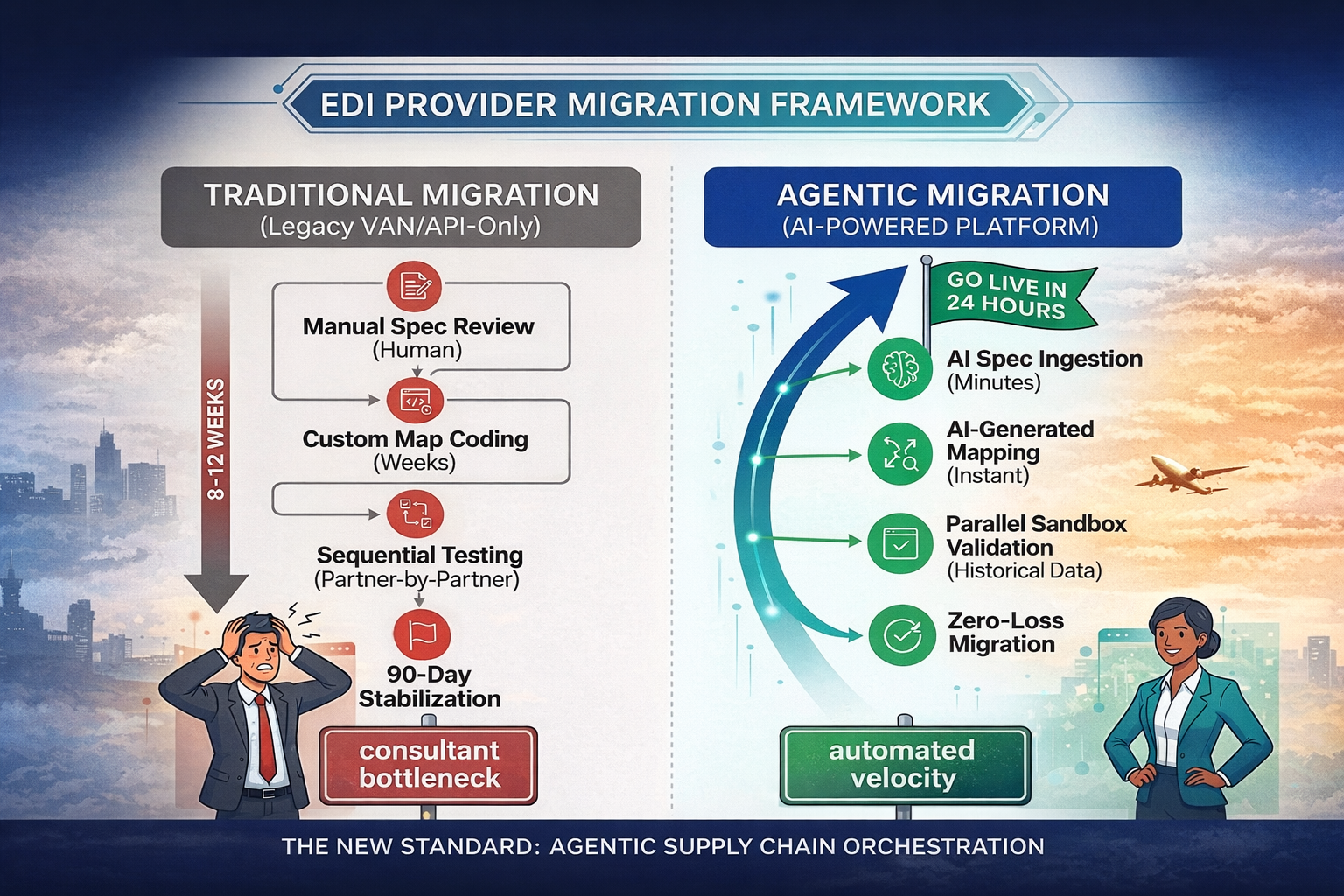
However, the shift from "Legacy VAN" models to Agentic Supply Chain Orchestration has changed the mechanics of the transition. By leveraging AI-driven mapping and automated validation, organizations can now migrate complex trading partner ecosystems without the traditional 90-day stabilization period.
The Hidden Costs of Legacy Migration Models
Traditional migrations follow a linear, human-dependent path:
1. Manual Spec Review: A project manager manually reviews thousands of pages of partner guidelines.
2. Custom Code Mapping: Developers write specific translation logic for every document type (850, 810, 856).
3. Sequential Testing: Testing occurs partner-by-partner, creating a bottleneck that delays ROI.
This approach often results in "Migration Fatigue." When project managers manually review thousands of pages of partner guidelines and developers write unique code for every 850 or 856 document, the "Go-Live" date inevitably slips. A "consultancy-heavy" approach is why TrueCommerce or legacy providers often quote months for a full migration. It’s not a technical limitation; it’s a process limitation.
Why It's Time to Expect More from Your EDI Platform
This video offers a deep dive into how a unified platform like Cleo Integration Cloud provides the visibility and orchestration necessary to move beyond these traditional EDI limitations.
The Architecture of an AI-Driven Transition
To eliminate downtime, our platform treats EDI data as a dynamic schema rather than a static file format. Here is the technical breakdown of how we accelerate the move:
1. Automated Spec Ingestion
Instead of manual entry, our platform uses AI to ingest trading partner requirement documents (PDF, HTML, or Wiki). The AI identifies the specific mandatory segments, qualifiers, and code lists required by your customers (e.g., Walmart’s specific 856 ASN requirements).
2. Canonical Data Mapping
We decouple your ERP (such as NetSuite or Microsoft Dynamics 365) from the trading partner. Our AI maps your internal data to a Canonical Data Model. This means you only map your ERP once. When you add or move 500 trading partners, the AI simply "points" those partners to your existing canonical model, eliminating the need to write 500 individual maps.
3. Parallel Sandbox Validation
We don't test partners one by one. Our engine runs thousands of historical transactions through a "shadow" environment. This identifies potential mapping errors against real-world data before you ever flip the switch to production.
The 24-Hour Migration Milestone: From Handshake to Live Data
Timeline | Milestone | Technical Outcome |
Hour 0-4 | Environment Sync | Direct API/SFTP connection established between your ERP and our platform. |
Hour 4-12 | AI Mapping Generation | AI analyzes your most complex trading partner spec and generates the translation logic. |
Hour 12-20 | Integrity Testing | Automated "smoke tests" run 100+ historical documents to verify compliance. |
Hour 24 | Production Readiness | Your first high-priority trading partner is ready for live transaction flow. |
"We are performing vastly better than when we had with our previous third-party managed service provider handling EDI for us."

Conclusion
The primary risk of changing EDI providers is "Order to Cash" interruption. By utilizing an AI-driven framework that guarantees 24-hour onboarding for critical partners, that risk is effectively neutralized. You aren't just moving your data; you are upgrading the intelligence of your entire supply chain.
FAQs
Will my trading partners need to change their setup? No. Because we use an abstraction layer, your partners continue to send and receive data in their preferred format (X12, EDIFACT, etc.).
How do you handle custom EDI segments? Our AI spec-ingestion tool identifies non-standard qualifiers and maps them to your canonical model automatically.
What ERPs do you support? We provide native, AI-optimized connectors for NetSuite, Microsoft Dynamics 365, SAP S/4HANA, Sage, and more.
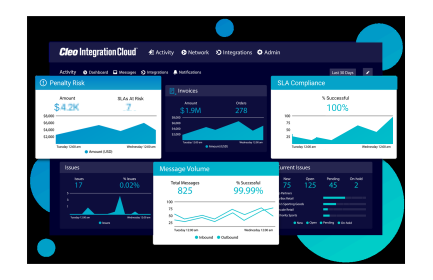
One platform. Every connection. Total control.
Onboard partners in hours, sync your back office instantly, and eliminate the errors that stall your revenue.
Technical Authority in Action: Migration Success Stories
Our migration framework isn't just a theoretical model; it is the engine behind some of the fastest-scaling supply chains in North America.
-

Victrola: From Manual Hurdles to Automated Excellence
How a global leader reclaimed control over their data flows.
Read Case Study -

Giltner Logistics: The 95% Onboarding Acceleration
A case study in achieving 24-72 hour partner activation.
Read Case Study -

Lipari Foods: Migrating 1,000+ Partners to the Cloud
Proof that massive scale doesn't have to mean massive downtime.
Read Case Study