Case Study Logistics & Transportation
How Giltner Transportation Reduced Onboarding Times to 3 Days
Switching to Cleo Integration Cloud decreased Giltner’s onboarding time by 95%

EXECUTIVE SUMMARY
Giltner Logistics implemented Cleo Integration Cloud (CIC) to unify fragmented Transportation Management Systems (TMS) across its business units and regain internal control over its integration strategy. By transitioning from a reactive, third-party reliant model to a blended self-service approach, Giltner reduced new customer onboarding time by 95% and shifted from onboarding 6–8 customers per year to 6–8 customers per month. This transformation eliminated data silos and provided 24/7 visibility into supply chain transactions, allowing the team to proactively resolve errors before they impact revenue.
KEY PERFORMANCE OUTCOMES
Massive Scaling of New Business: Enabled the company to handle a 10x increase in onboarding capacity, moving from an annual average of 8 customers to as many as 8 new customers every month.
Reduction in Integration Latency: Slashed the time required to activate full EDI setups with new customers from two months to less than 72 hours.
Elimination of "Reactive" Troubleshooting: Replaced third-party dependency with internal "CIC Cockpit" visibility, allowing Giltner to identify and fix errors in-house before customers were even aware of an issue.
Unified Data Architecture: Resolved data inconsistencies caused by disparate TMS platforms by centralizing all B2B transactions through a single cloud-based integration hub.
Strategic "Self-Service" Autonomy: Empowered the internal IT team to perform testing, troubleshooting, and minor mapping alterations, drastically reducing reliance on external consultants for revenue-critical tasks.
INTRODUCTION
Established in 1982 in Idaho, Giltner consists of several different business units in the transportation and logistics space with the two largest being Giltner Transportation and Giltner Logistics. The Transportation unit is primarily focused on refrigerated freight but also services other modes including heavy haul. The Logistics unit provides 3PL service such as, warehousing, international, and LTL services.
BUSINESS NEEDS
In the early 2020s, Giltner management started to notice that some areas of its businesses and certain processes could not accommodate the growth it was experiencing.
The reason? A fundamental lack of control. This lack of control stemmed largely from inadequate self-service options, meaning Giltner had to rely heavily on outside parties to complete revenue-critical integration tasks. This impacted multiple areas of Giltner’s businesses, including onboarding, integration, data collection, and error resolution.
Giltner realized it needed to onboard customers faster to keep up with the high volume of new business it was winning. There was also the aspect of poor integration between systems. This lack of integration resulted in sub-par data collection and accuracy. A third dilemma was issue identification and error resolution. Giltner had poor visibility into supply chain processes and transactions, which meant it was difficult for them to identify and fix errors promptly.
The combination of these issues was hindering Giltner’s success and the company knew it had to make technological changes.
IT CHALLENGES
Each of Giltner's businesses had its own TMS (transportation management system), and each unit was struggling with integrations in their platforms. The integration process is labor-intensive and complex, requiring countless manual and repetitive tasks. This caused inconsistencies between integrations which impacted data collection and accuracy company-wide.
When it came to onboarding new trading partners, this too was a timeconsuming process. Giltner was only onboarding about six to eight new customers annually, reflecting a highly inefficient process that was begging for improvement. Additionally, whenever Giltner’s customers updated their systems, the logistics company would normally have to update its TMSs to remain compliant with the new requirements, but this too had grown cumbersome.
Then there was also the issue of error notification. Giltner found that its processes for error identification were very reactive, as the company would only discover a problem after it had occurred. Because there was zero visibility into transactions, the company was not able to see or correct issues proactively and was often only notified of an issue from a customer.
These problems began to further magnify because the company was rapidly growing, propelling the Giltner team to start searching for reliable solutions that could address and fix the issues at hand.
“We wanted to be self-service at the end. So the Cleo team built the basic constructs of what our partner connections would look like, and then my team and I would actually do the testing, troubleshooting, and some of the minor alterations to those kinds of processes. The hands-on learning made it easier for us and we learned so much from it.”
THE SOLUTION
Giltner became a Cleo and Cleo Integration Cloud (CIC) customer in 2020. The first order of business was to get the CIC software implemented and deployed which involved a cloud migration. Cleo helped with the initial setup to get Giltner up and running with the platform, and still helps out occasionally when the company does not have the internal bandwidth for certain projects.
VP of Technology, Todd Baughman said, “We wanted to be self-service at the end. So the Cleo team built the basic constructs of what our partner connections would look like, and then my team and I would actually do the testing, troubleshooting, and some of the minor alterations to those kinds of processes. The hands-on learning made it easier for us and we learned so much from it.”

Harnessing Cleo’s flagship product, CIC, Giltner was swiftly able to tackle all integration and EDI challenges while simultaneously making vital operational improvements, including:
Integrating B2B transactions into various TMSs across all businesses
A 95% decrease in onboarding time—from eight weeks on average to three days
A 92% increase in the total number of customers onboarded annually— from six to eight customers onboarded annually, to six to eight customers monthly
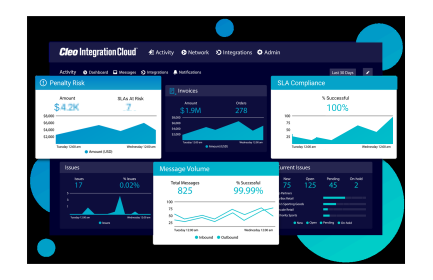
Visibility into errors, allowing Giltner to proactively fix issues
When asked about how Cleo impacted Giltner’s onboarding times, Baughman said, “It was taking eight weeks to set up a new customer. Now we can do it in less than three days. And nine times out of 10, we have been able to activate a full EDI setup with a customer in less than three days as well.”
LOOKING FORWARD
Giltner has implemented Cleo into some of its businesses but not yet all of them. Accordingly, the Giltner team is analyzing which businesses would benefit most from Cleo technology and services. Some Giltner businesses will benefit more from the transactional EDI integration benefits, while others will benefit more from the API capabilities that enable seamless data flows.
Additionally, Giltner has a bevy of trading partners that preceded the deployment of ClC. The company is currently assessing which trading partners it should move to the Cleo Integration Cloud platform to obtain better visibility into processes and data.
Giltner plans to continue putting more processes onto the Cleo platform to drive consolidation while taking advantage of CIC’s multiple benefits.

EXPECT MORE FROM YOUR INTEGRATION PLATFORM
Cleo Integration Cloud (CIC) unifies API, EDI, and MFT into a single AI-native ecosystem for supply chain orchestration.
- Instant Onboarding: Connect new partners in hours, not months.
- Order Fulfillment: Automate end-to-end lifecycles of POs, ASNs, and invoices.
- Total Visibility: Track every order from "buy" to "pay" in real-time.
- ERP/TMS/WMS Integration: Deep, pre-built connectors for your tech stack.
- Zero Chargebacks: Eliminate the manual errors that drain your margins.
- Agile Scaling: Move from basic compliance to full orchestration.
- Operational Control: Choose between self-service or managed success.




Founded
1982
HEADQUARTERS
Idaho
INDUSTRY
Transportation / Logistics
INTEGRATION SOLUTION
Cleo Integration Cloud (CIC) / Blended Services
BY THE NUMBERS
95%
Decrease in onboarding time— from eight weeks on average to three days
92%
Increase in the total number of customers onboarded annually— from six to eight customers onboarded annually, to six to eight customers monthly
Additional Benefits
Harnessed cloud technology & intuitive self-service for total process control. Gained real-time visibility with customizable reports & alerts. Communicated with customers directly via CIC platform. Used Cleo’s on-demand blended services as business grew.
One platform. Every connection. Total control.
Onboard partners in hours, sync your back office instantly, and eliminate the errors that stall your revenue.
Additional Case Studies You Might Like
Discover how Cleo has transformed businesses like yours.
-

Verst Reduces Error Rate by 94%
Verst Logistics chose Cleo Integration Cloud for all EDI and API needs, leading to ability to say “yes” to more of API requirements and EDI mandates, all while lowering their error rate from 4% to 0.24%.
Read Case Study -

Mohawk Global Gains 24/7 Real-Time Supply Chain Visibility
Mohawk Global needed to eliminate manual data gaps and accelerate client onboarding. Learn how they used Cleo to automate EDI and API integrations, providing total visibility and faster growth for their 3PL operations.
Read Case Study -

Century Reduced Partner Onboarding Time by 75%
With Cleo, Century has achieved rapid, sustainable growth across every facet of its integration landscape. And as their needs have expanded. Cleo’s platform has scaled effortlessly to keep pace.
Read Case Study