Definitive Guide to Supply Chain Orchestration in 2026

Aaron Keeports
Supply chain orchestration is an evolving strategy that focuses on uniting a supply chain's fragmented processes, systems and data into a single point of control.
Gartner named Cleo a Representative Vendor in its Market Overview for Supply Chain Orchestration Platforms. The research identifies orchestration platforms as the connective layer between supply chain strategy and execution, supporting network-centric operations and agentic decision-making across increasingly complex supply chains.
In this blog:
- What is Supply Chain Orchestration?
- Why is Supply Chain Orchestration Important?
- Supply Chain Orchestration Capabilities
- The Three Pillars of the Execution-Layer Anchor
- Supply Chain Orchestration Use Cases
- The 2026 Supply Chain Orchestration Maturity Model
- Hard Facts & ROI on Supply Chain Orchestration
- FAQs on Supply Chain Orchestration
Supply chain operation makes or breaks business growth.
In 2026, cost pressure is relentless, customer expectations are high and disruptions are unpredictable. And it's safe to say businesses that manage supply chain processes in silos are being blindsided even harder by costs.
The companies winning are those that are able to uniformly coordinate data, systems, and processes across their entire supply chain network. This is accomplished through supply chain orchestration.
But what is supply chain orchestration, why does it matter and what ways can you leverage this strategy? Let's begin with the supply chain orchestration definition.
What is Supply Chain Orchestration?
Supply chain orchestration (SCO) is a strategy oriented through powerful supply chain integration, in which the data, systems and processes of a supply chain are automated, managed and centralized through a single point of control. While traditional supply chain management (SCM) often operates in silos, orchestration ensures that these data flows, systems and processes are integrated into one fluid operation.
As a product of supply chain integration, supply chain orchestration enables the real-time and synchronized control over every B2B process in your supply chain. This is accomplished by consolidating the typically fragmented integration capabilities (API integration, EDI integration and file based integration) into a single solution.
Unlike legacy integration, which focuses on data movement, Cleo Integration Cloud, a leading supply chain orchestration platform, serves as the Execution-Layer Anchor, unifying API integration, EDI integration, and file based integration in a single solution.
The result? Faster, more informed decisions for every supply chain network, 85% faster time to resolve errors and 24-hour trading partner onboarding time.
Why is Supply Chain Orchestration Important?
Today, supply chain processes are fragmented, meaning hours of retyping orders, days of diagnosing transaction and integration errors, and thousands of dollars paid in compliance violations and lost revenue. Much of this fragmentation is due to multiple data integration solutions (EDI, API and MFT) into various systems (like ERPs, accounting and shipping software, TMSs, WMSs and more) and for many different suppliers and partners.
Without a unified view and single point of control, businesses stay trapped in a cycle of manual reconciliation for every transaction, restricting business growth.
Supply chain orchestration collapses these gaps by enabling real-time visibility into every end-to-end business process. Allowing everything in your supply chain to be connected with the combined power of API integration, EDI integration, file based integration and more in a single platform.
Once implemented, what were once disparate data points become a single, automated engine for supply chain visibility but more importantly, decision-making.
Why Legacy Integration Falls Short in 2026
For years, “integration” was the north star of supply chain transformation. Connect your ERP to your warehouse. Adopt EDI. Add APIs for modern workflows. Bring suppliers, customers, carriers, and 3PLs into one ecosystem.
But in 2026, supply chain leaders are learning a hard lesson. Data movement does not equal execution.
Legacy integration platforms were built to connect systems and exchange documents. They do that job well, but they often break down when the supply chain shifts from “business as usual” into disruption mode. Disruption mode is no longer occasional. It is constant.
The Execution Gap: Seeing the Problem vs. Fixing the Problem
The biggest limitation of legacy integration is what most teams experience every day. You can see what’s happening, but you cannot act fast enough to change the outcome.
This is the execution gap, the space between visibility and orchestration:
- Visibility: identifying risk or a breakdown (late shipment risk, missing acknowledgement, ASN mismatch, invoice discrepancy, failed transaction, compliance violation)
- Orchestration: coordinating action fast enough to prevent disruption, chargebacks, late delivery, or customer escalation
In many organizations, exceptions trigger alerts, but resolution still depends on humans digging through messages and coordinating across multiple partners and systems. That is where delays compound and disruption spreads.
What the Execution Gap Looks Like (Two Everyday Examples)
Example 1: A missed PO acknowledgement creates fulfillment risk
Your system receives an order, but the acknowledgement does not confirm as expected. Legacy integration may flag the problem, but if it takes days to diagnose and resolve, you lose time. The result is late shipment risk and downstream OTIF impact.
Example 2: An ASN mismatch disrupts receiving
An ASN is sent, but carton content does not match what the warehouse expects. The shipment gets held or rejected, receiving schedules get disrupted, and teams end up coordinating manually across trading partners.
These are not rare scenarios. They are daily friction points that cause supply chains to feel permanently reactive.
Integration vs. Supply Chain Orchestration: What’s Really Different?
Supply chain orchestration is the strategic coordination of end-to-end processes across a multi-enterprise network. It goes beyond integration by connecting real-time visibility with automated workflows, faster resolution, and aggregate data. This helps organizations protect outcomes like OTIF, service levels, and revenue.
Think about it like this:
- Integration asks, “Can we connect and exchange information?”
- Supply chain orchestration asks, “Can we continuously coordinate processes, data, and decisions across the network from one location, then take action fast when conditions change?”
Orchestration turns the supply chain from a system that reports issues into one that actively prevents them from becoming disruptions. In an orchestrated supply chain, visibility and action are connected so teams can respond before disruption spreads.
Supply Chain Orchestration Capabilities Chart
Capability | Legacy Integration (EDI/API) | Supply Chain Orchestration |
Primary Focus | Data Connectivity | Outcome governance (OTIF, resilience, service) |
Issue Handling | Alerts + manual triage | Automated workflows, AI-powered issue resolution and guided next steps |
Visibility | Transaction-level, often siloed between systems | End-to-end process context across partners and systems |
Decision Support | Human interpretation | Real-time data, trend forecasting, and prioritization on business impact |
Partner Performance | Hard to measure consistently | Scorecarding + continuous feedback loop |
Resilience | Depends on response time | Designed to prevent disruption and repeat issues |
The shift from connectivity alone to end-to-end supply chain orchestration is why orchestration is emerging as the next evolution beyond integration.
Who Are the Leaders in the Supply Chain Orchestration Market?
The supply chain orchestration market is not a single category. Vendors enter it from different starting points, and the right shortlist depends on where your execution actually breaks down.
Gartner named Cleo a Representative Vendor in its Market Overview for Supply Chain Orchestration Platforms, research that identifies orchestration platforms as the connective layer between supply chain strategy and execution.
Broadly, the vendors competing in supply chain orchestration fall into four groups.
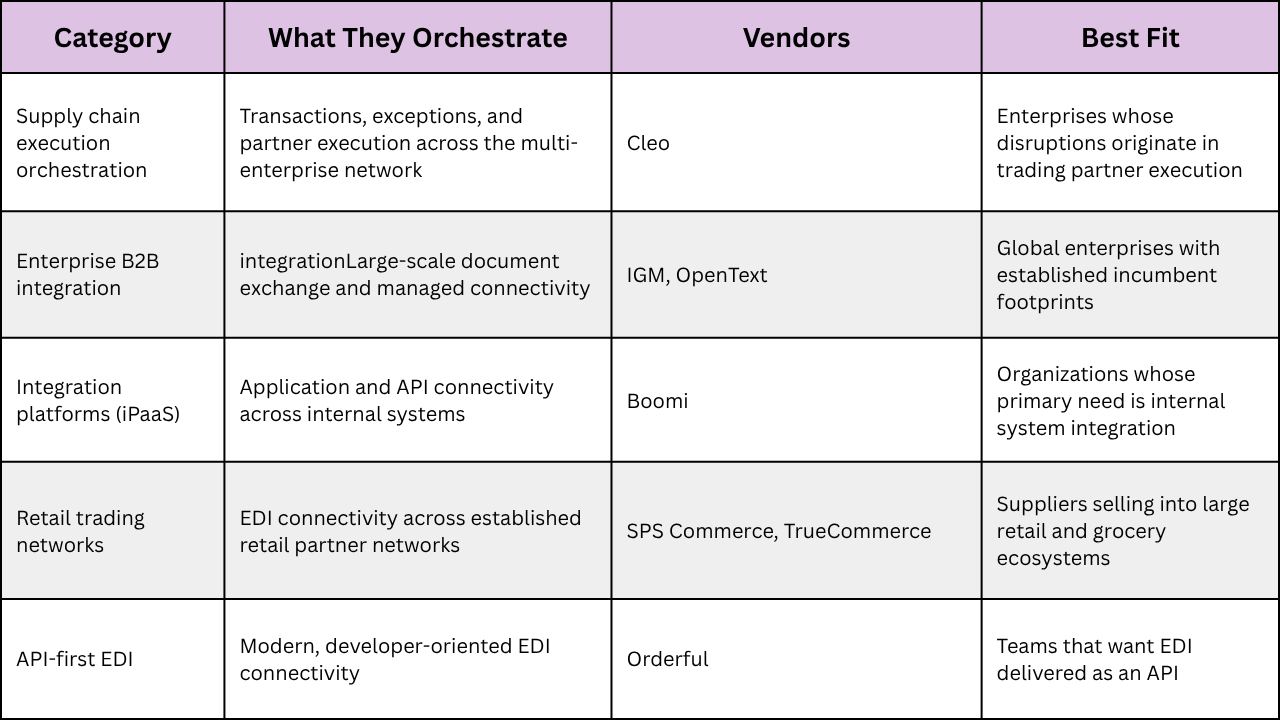
Execution-layer orchestration platforms coordinate what happens after a transaction leaves your systems. Cleo Integration Cloud unifies EDI, API, and managed file transfer connectivity with real-time visibility and agentic resolution, so exceptions get detected and resolved before they become disruptions. IBM and OpenText both bring long-established enterprise B2B integration footprints, and are common incumbents in large, complex environments.
Integration platforms like Boomi are strongest when the problem is connecting internal applications and building API workflows. They are frequently deployed alongside an execution layer rather than instead of one, because internal connectivity and partner execution are different problems.
Retail trading networks such as SPS Commerce and TrueCommerce are built around large, pre-established retail partner networks. If most of your volume flows to a handful of major retailers, that network coverage can be the deciding factor.
API-first EDI providers like Orderful modernize how EDI is consumed, exposing it through APIs so engineering teams can work with familiar tooling. They tend to fit organizations with strong internal development resources.
It is also worth distinguishing orchestration from supply chain planning. Vendors including Blue Yonder, Kinaxis, and o9 Solutions orchestrate planning decisions such as demand, supply, and inventory. Execution-layer platforms orchestrate what happens once those plans meet real trading partners. Most enterprises end up running both.
The Three Pillars of the Execution-Layer Anchor
Supply chain orchestration creates business value by reducing friction across a global trading partner ecosystem. It breaks down silos, improves visibility, accelerates resolution, and helps teams become proactive rather than reactive.
In 2026, speed matters. The organizations that win are not the ones that only move data faster. They are the ones that can manage outcomes in real time.
Connectivity, Visibility, and Actionable Intelligence
Supply chain orchestration depends on three capabilities. Unified connectivity, real-time visibility, and actionable intelligence. This is what smart supply chain orchestration looks like in practice, a system that helps teams prioritize and act, not just monitor.
Unified Connectivity (API + EDI + MFT)
Most supply chains use a mix of automated EDI, APIs, and managed file transfer (MFT) to work with different partners, systems, and compliance requirements.
When those connection types sit in different tools, data fragments across teams and processes. In disruption mode, that fragmentation slows response and weakens resilience.
A single platform for API, EDI, and MFT reduces fragmentation and creates one place to manage partners, track activity, and standardize workflows. Cleo Integration Cloud unifies all three connectivity types alongside visibility and governance.
Real-Time Visibility
Real-time visibility is often described as seeing what is happening. In orchestration, it also means understanding what is at risk and what to do next.
In other words, visibility is not just a dashboard. It is the ability to spot gaps between planned and actual execution, then close them before they become disruptions.
These gaps can show up as OTIF risk, delayed confirmations, inconsistent shipment milestones, or recurring partner friction that slows fulfillment and payment.
Agentic Resolution
Orchestration still breaks down if response is slow. Agentic resolution helps teams move faster from "what happened?" to "fix it now" by prioritizing, recommending next steps, and coordinating action across partners. In Cleo Integration Cloud, this is delivered through Cleo AI.
Agentic resolution helps teams:
- Understand what is most likely driving a breakdown
- Recommend the next best action based on context and historical patterns
- Coordinate resolution steps across systems and trading partners
- Reduce repeat problems by standardizing what works
This is about protecting flow so routine breakdowns do not turn into missed delivery windows, chargebacks, or customer escalations.
When unified connectivity, real-time visibility, and agentic resolution work together, supply chain orchestration becomes practical. You get a clearer network view, faster coordinated response, and a system that helps teams keep outcomes on track as conditions change.
Supply Chain Orchestration Use Cases: The Neighborhood Strategy
Supply chain orchestration can sound abstract until you map it to the workflows that carry the most business risk. That is why this guide focuses on three “neighborhoods” where orchestration has clear, measurable impact. These neighborhoods also align with how many buyers research solutions today, starting with the outcomes they need to protect.
Those three neighborhoods are order-to-cash, ERP modernization, and resilience across multi-enterprise networks.
Orchestrating the Order-to-Cash Cycle
Order-to-cash is where supply chain execution and revenue collection collide. When something breaks in this cycle, the impact shows up quickly. Orders get delayed, deliveries miss customer requirements, invoicing slows down, and payments arrive later than they should.
Supply chain orchestration helps reduce that friction by automating the last mile between your ERP and your customers. It is how Cleo helps you “get paid” by keeping order and fulfillment processes aligned across systems and trading partners, then coordinating fast action when changes occur.
Here are common order-to-cash workflows where orchestration matters:
- Keeping orders, confirmations, and changes aligned across customers and internal systems
- Coordinating shipment execution to meet customer requirements and delivery windows
- Reducing disputes by improving process consistency across documents and milestones
- Accelerating resolution when a delivery, invoice, or payment is at risk
- Creating a cleaner path from fulfillment completion to accurate invoicing
ERP Modernization for NetSuite, SAP, and D365
ERP modernization can be a high-risk period for supply chain execution. Your business may be transforming internal systems, but your trading partner ecosystem does not pause. Customers still expect on-time delivery. Suppliers still need clear requirements. Carriers and 3PLs still need accurate documents and timelines.
Organizations running Oracle Fusion often address financial orchestration as part of the same modernization program.
Cleo Integration Cloud is positioned as the essential bridge for companies migrating to SAP S/4HANA, Dynamics 365, or scaling NetSuite.
Supply chain orchestration supports ERP modernization by helping organizations:
- Keep partner-facing workflows stable while internal systems shift
- Reduce risk by coordinating changes across documents, partners, and business processes
- Support phased migrations without interrupting customer and supplier operations
- Preserve service levels and OTIF during go-live and post-go-live transition
- Scale partner onboarding and process changes without creating bottlenecks
Multi-Enterprise Business Networks and Resilience Beyond Your Four Walls
For global supply chain orchestration, the value comes from coordinating partners across regions and time zones with shared visibility and faster response.
Most disruption is not created inside your four walls. It happens at the edges, where suppliers, contract manufacturers, carriers, 3PLs, distributors, and customers interact. That is why resilience depends on coordinated execution across the network, not just internal optimization.
Multi-enterprise business networks are where global supply chain orchestration becomes practical. You are not only connecting partners. You are coordinating execution across them using aggregated network data so teams can detect risk early, align action, and improve performance over time.
Orchestration supports collaboration beyond your four walls by enabling:
- A shared view of execution across partners, shipments, and critical milestones
- Faster coordination when conditions change, such as delays, shortages, or capacity constraints
- Performance measurement that makes partner accountability actionable, not theoretical
- A repeatable improvement cycle through scorecards, standard workflows, and governance
The 2026 Supply Chain Orchestration Maturity Model
Supply chain orchestration is not a switch you flip. Most organizations evolve into it over time as they consolidate connectivity, standardize workflows, and build the operating discipline needed to manage outcomes across a complex ecosystem.
Phase 1: Stabilization
The goal of stabilization is to reduce complexity and create a reliable foundation. Many organizations enter this phase when legacy EDI tooling, custom scripts, and point solutions can no longer keep up with partner demands.
In this phase, the focus is moving from legacy EDI and fragmented connectivity into a unified platform that can support EDI, APIs, and managed file transfer in a consistent way. The business outcome is simple. Fewer breakdowns, clearer ownership, and more predictable execution.
Common Phase 1 priorities include:
- Consolidating partner connectivity so critical flows are managed in one place
- Standardizing partner onboarding and reducing dependency on custom work
- Creating baseline visibility across orders, shipments, and partner activity
- Establishing governance so issues are tracked, prioritized, and resolved consistently
Phase 1 success looks like a supply chain that is more stable and less dependent on manual workarounds and urgent escalations.
Phase 2: Optimization
The goal of optimization is to reduce manual effort and improve performance in the workflows that create the most friction and revenue impact. This is where orchestration starts to become tangible because automation is applied to end-to-end processes, not just single transactions.
In this phase, organizations typically focus on automating key flows, such as order-to-cash automation and procure-to-pay automation. The emphasis is on consistency, speed, and fewer handoffs between systems and teams.
Common Phase 2 priorities include:
- Automating O2C and P2P workflows so execution is more predictable
- Improving exception handling through workflows, routing, and guided resolution
- Reducing disputes and rework by standardizing process logic across partners
- Using aggregated data to identify recurring breakdowns and eliminate root causes
- Introducing performance measurement, including OTIF tracking and partner scorecarding
Phase 2 success looks like fewer manual interventions and steady improvement in service and cycle times.
Phase 3: Orchestration
The goal of orchestration is predictive resilience. In this phase, the organization is not only automating workflows. It is using real-time data and intelligence to prevent disruptions and coordinate response across the network before outcomes are impacted.
This is where AI becomes most valuable. Not as a replacement for teams, but as a co-pilot that reduces the time needed to diagnose issues, prioritize what matters, and drive consistent resolution across partners and systems. Cleo AI applies this across partner transactions, surfacing likely root causes and recommending next steps before an exception becomes a disruption.
In Phase 3, predictive resilience means the platform reduces manual intervention and accelerates disruption resolution across the network. Cleo states it can resolve operational disruptions 85% faster than legacy integration middleware.
Common Phase 3 priorities include:
- Predictive detection of risk based on patterns, trends, and partner behavior
- Automated and AI-assisted resolution to reduce response time and prevent disruption
- Continuous optimization through scorecards, governance, and repeatable workflows
- Executive-level visibility into network performance and risk, not just transaction status
Hard Facts & ROI on Supply Chain Orchestration
The Impact of Supply Chain Orchestration by the Numbers
When supply chain orchestration connects unified connectivity with real-time visibility and AI-assisted action, teams stop measuring success by “messages delivered” and start measuring it by outcomes protected, like OTIF, service levels, and cash flow.
Here are four ROI-oriented metrics that summarize what orchestration is designed to improve at scale.
- 85% reduction in manual issue resolution time
- Less time spent triaging routine exceptions and coordinating fixes across systems and trading partners.
- 24-hour goal for full trading partner onboarding
- Faster onboarding means you can add partners, customers, and channels without stalling operations.
- 35% faster time-to-cash in high-volume retail environments
- Automation across order-to-cash reduces delays that typically slow invoicing, payment, and dispute resolution.
- 99.9% SLA compliance across multi-enterprise networks
- Higher reliability across connected partners helps protect service level agreements even as the network gets more complex.
Ready to Orchestrate a More Resilient Supply Chain?
Supply chain orchestration is the shift from moving data to managing outcomes across a complex network of partners, systems, and processes. With unified connectivity, real-time visibility, and actionable intelligence, organizations can protect OTIF, improve partner performance, and respond faster when conditions change.
If you have questions or want to see what orchestration can look like for your business, reach out to our team at sales@cleo.com. For more informational content on supply chain orchestration, integration, and trading partner performance, explore the Cleo Content Hub.
FAQs on Supply Chain Orchestration
Find answers to the most commonly asked questions on supply chain orchestration.
What is supply chain orchestration?
Supply chain orchestration is the coordination of end-to-end supply chain processes across partners and systems using unified connectivity, real-time visibility, and actionable intelligence. The goal is to protect outcomes like OTIF, service levels, and time-to-cash by aligning execution across the network.
Who are the leaders in the supply chain orchestration market?
The supply chain orchestration market includes established integration vendors, supply chain planning platforms, and execution-layer specialists. Gartner named Cleo a Representative Vendor in its Market Overview for Supply Chain Orchestration Platforms. Leaders are typically evaluated on unified connectivity across API, EDI, and managed file transfer, real-time network visibility, partner onboarding speed, and proven outcomes tied to OTIF and time-to-cash.
What is the difference between supply chain orchestration and integration?
Integration connects systems so data can move between applications and trading partners. Orchestration goes further by coordinating processes, data, and decisions across the network so teams can act faster when conditions change and prevent disruptions from spreading.
What are the key capabilities of a supply chain orchestration platform?
Most supply chain orchestration platforms focus on three core capabilities. Unified connectivity across API, EDI, and managed file transfer. Real-time visibility across orders, shipments, inventory, and partner activity. Actionable intelligence that helps teams prioritize, coordinate response, and improve partner performance through scorecarding.
What types of companies benefit most from supply chain orchestration software?
Any organization with a complex trading partner ecosystem can benefit, especially those in manufacturing, retail, distribution, and logistics. Orchestration is most valuable when execution depends on many external partners and when disruptions create measurable financial or service-level impact.
How does supply chain orchestration improve OTIF?
Orchestration improves OTIF by spotting risk earlier, coordinating action across partners and internal teams, and reducing repeat breakdowns through performance tracking. Instead of discovering problems after a missed commitment, teams can respond faster and prevent issues from escalating.
How do you evaluate supply chain orchestration tools in 2026?
Evaluate platforms based on whether they unify API, EDI, and MFT, deliver real-time network visibility, and support coordinated action at scale. If you are comparing top vendors for end-to-end supply chain orchestration, focus on partner onboarding, workflow automation, scorecarding, and proven outcomes tied to OTIF, resilience, and cash flow.
What is the best supply chain orchestration platform for 2026?
The best supply chain orchestration platforms unify connectivity across API, EDI, and managed file transfer, provide real-time network visibility, and support coordinated action at scale. Gartner named Cleo a Representative Vendor in its Market Overview for Supply Chain Orchestration Platforms. Cleo positions its approach as AI-native and states it can resolve operational disruptions 85% faster than legacy integration middleware.
How does supply chain orchestration differ from EDI?
EDI is a standard for exchanging business documents between trading partners. Supply chain orchestration is broader. It governs the end-to-end transaction lifecycle across partners and systems by combining EDI with APIs, managed file transfer, real-time visibility, workflow automation, and intelligence that helps teams coordinate action and protect revenue outcomes.

Supply Chain Orchestration with Cleo
Cleo Integration Cloud bridges the gap between enterprise planning and real-time execution.


