Procure-to-Pay Automation vs AP Automation: What’s the Difference?

Aaron Keeports
When businesses try to identify the most critical stage of their procurement processes, they may jump to the very last stage – invoicing. Often procurement operations roll up to the Chief Financial Officer, are interwoven into budgeting, and signify the number one cost center for the business – purchasing and storing materials used in direct manufacturing.
It does make sense to think about automating procurement with a particular focus on digitizing invoices and payments. But, that is a danger to the health of the business. In reality, true Procure-to-Pay (P2P) automation begins long, long before the payment stage.
Before an invoice can be processed or a payment approved, purchase orders, purchase order acknowledgements, shipment notices, and receipts must move seamlessly between your ERP and your suppliers.
That’s where Cleo Integration Cloud (CIC) comes in. Cleo delivers end-to-end P2P automation by connecting, transforming, and orchestrating every upstream data flow that leaves or enter your ERP — ensuring that when it’s time for accounts payable (AP) automation to take over, all the data is already accurate, consistent, and ready for action.
Cleo’s Procure-to-Pay Automation is a Bridge to Accounts Payable Automation
It’s important to distinguish between Procure-to-Pay (P2P) automation and Accounts Payable (AP) automation. While they’re closely connected, they serve very different purposes within the enterprise ecosystem.
Procure-to-Pay (P2P) Automation
P2P automation connects and orchestrates data across procurement, fulfillment, and payment readiness. It’s designed to manage the flow of transactions on the edge of your ERP between your business, suppliers/vendors, and internal systems — from purchase orders and shipment notices to goods receipts and invoices.
With Cleo Integration Cloud (CIC), P2P automation goes even further by:
- Facilitating communication with suppliers through EDI, API, and file-based integrations
- Transforming and mapping data between disparate systems to ensure ERP-ready consistency (this includes WMS, TMS, PIM, MRP and others)
- Providing real-time visibility into every document and transaction across your supply chain (suppliers, 3PLs/carriers, customers and more)
- Exception management to handle issues from integration errors to supplier responses that break business conditions.
- Supplier performance monitoring and scorecarding
In short, Cleo ensures every upstream process runs smoothly and every system stays in sync — creating the clean, validated, structured data that procurement and finance teams rely on.
Accounts Payable (AP) Automation
AP automation — often referred to as Accounts Payable and Invoice Automation (APIA) — operates inside the ERP (or as an attached module or standalone tool). Its purpose is to manage the payment phase of the process: detecting fraud, routing approvals, reconciling invoices, and executing payments. Solutions like Tipalti, Stampli, and Procurify specialize in these financial workflows.
While AP automation handles what happens after an invoice enters the ERP, Cleo ensures that invoice arrives clean, complete, and consistent in the first place. Cleo delivers invoices into the ERP from any supplier — whether they send EDI, PDFs, APIs, or other formats — and ensures all upstream procurement and fulfillment data is accurate, validated, and available in real time.
By the time AP automation takes over, every transaction is already aligned with POs, receipts, and shipment data, enabling faster, error-free payment processing.
Think of it like a relay race: Cleo handles everything leading up to payment — connecting systems, partners, and data — then passes a clean, complete baton to your AP automation tools to finish the process strong.
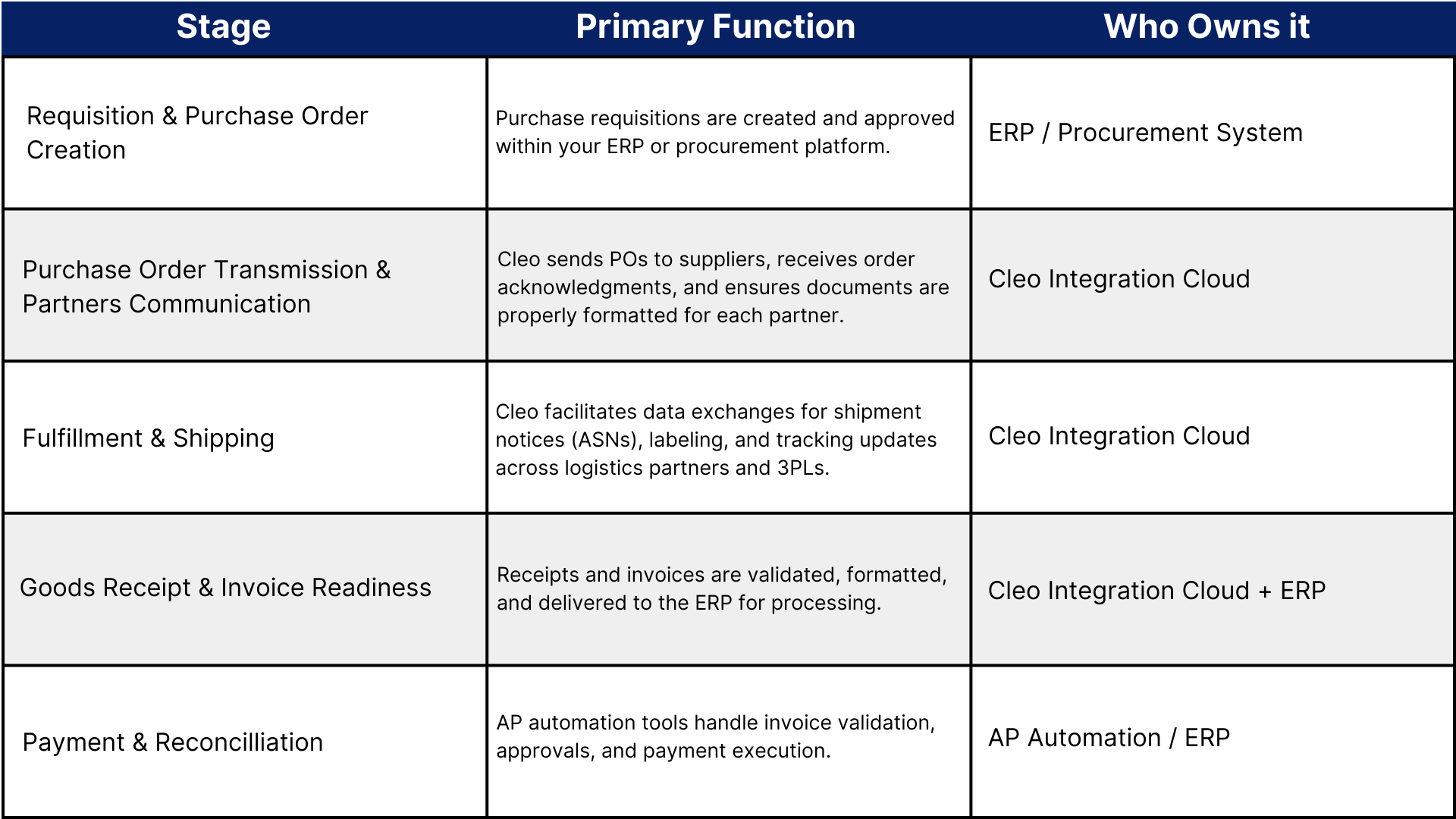
Where Cleo Fits in the Procure-to-Pay Journey
Cleo Integration Cloud sits at a critical point in the P2P lifecycle — where data moves between your external ecosystem and internal business systems.
While many organizations focus on automating what happens inside the ERP, the majority of operational complexity actually occurs outside of it. That’s where Cleo delivers value — by connecting, transforming, and monitoring all the data that needs to flow into the ERP before procurement and AP automation can take over.
Without Cleo, procurement automation tools often operate in silos — relying on manual uploads, delayed acknowledgments, or inconsistent partner data. That can lead to slower order cycles, invoice discrepancies, and poor supplier relationships.
With Cleo, all that friction disappears:
- Every supplier/vendor connection is unified on a single platform no matter how tech savvy they are
- Every transaction — from PO to invoice is visible and traceable not only in your ERP but also within a real-time dashboard where all supply chain flows are visible
- Every ERP workflow receives validated, ready-to-use data
In short, Cleo ensures P2P automation starts clean and stays connected — empowering your procurement and finance teams to focus on strategy, not data wrangling.
Procure-to-Pay Integration Is The Foundation of AP Automation Success
Procurement and payment automation can’t deliver full value without a strong integration and data foundation — and that’s exactly what Cleo Integration Cloud (CIC) provides.
Cleo doesn’t replace your ERP or AP automation tools — it empowers them. By connecting every partner, process, and transaction across your supply chain, Cleo ensures data moves accurately and transparently from purchase order to invoice.
Through this seamless orchestration, Cleo delivers true procure-to-pay (P2P) automation — complete with real-time visibility, reliable data flows, and end-to-end control.
When it’s time for AP automation to validate and process post-invoice steps, everything it needs is already clean, complete, and ready to go — no manual fixes, no delays, no uncertainty.
In the end, Cleo moves and transforms the data while your procurement and AP systems execute the transactions. Together, they create a connected, efficient, and fully automated P2P experience that drives performance, accuracy, and trust across your entire ecosystem.
Interested in how Cleo can help automate your procure-to-pay process or how we can help integrate with your ERP? Contact one of our experts here or email our team at sales@cleo.com. Not ready to have a conversation? Explore more resources at cleo.com/search.
Procure-to-Pay Automation vs AP Automation: What’s the Difference?
Discover the difference between P2P and AP automation. Learn how Cleo ensures clean, connected, ERP-ready data to power faster, error-free AP automation.


