Top Web EDI Providers of 2026
In this blog, we discuss the top Web EDI providers to consider in 2026. Topics include:
What Is a Web EDI Provider
Electronic Data Interchange (EDI) is the standardized, electronic method businesses use to exchange important documents—such as 855 purchase orders, 810 invoices, and 856 shipping notices—with their trading partners. Instead of relying on paper, fax, or email, EDI ensures these transactions are shared quickly, securely, and in a format both parties’ systems can understand.
A web EDI provider delivers this capability through a browser-based portal. Rather than installing software or building costly custom integrations, companies can log into a secure online platform to send, receive, and manage EDI transactions directly in the cloud.
This makes web EDI especially attractive for:
- Small and medium-sized suppliers and manufacturers that need to meet a retailer’s EDI compliance requirements without investing in a full integration platform
- Businesses that want to reduce manual paper or email-based processes
- Organizations with limited IT resources that need a simple, affordable way to become EDI-capable
For example, a supplier working with Target might use a Web EDI provider to receive purchase orders, and then send acknowledgments, ship notices, and invoices—all without needing a dedicated IT team or complex system integration.
In short, Web EDI providers make it easy for small and mid-sized businesses to get started with EDI quickly at a low cost of entry. And for many, Web EDI serves as a stepping stone toward more advanced solutions like Cleo Integration Cloud which goes beyond a web portal to provide API support, flexible service offerings (self, managed, blended), AI-capabilities, and more for true supply chain orchestration.
Signs Your Business is Ready for Web EDI
Not every company needs Web EDI right away, but there are clear signals that it might be time to move beyond paper, fax, or email processes. If your business is experiencing any of the following, Web EDI can provide a near-immediate benefit:
1) Retailer or 3PL Compliance Requirements
Large retailers, grocers, and logistics providers often mandate that suppliers exchange orders, invoices, and ASNs electronically. If you’ve been asked to “get EDI-capable,” a Web EDI portal is one of the fastest ways to meet those requirements.
2) Growing Order Volume
Manually processing orders and invoices works at low volumes, but it quickly becomes unmanageable as transactions scale. Web EDI reduces manual effort and helps prevent costly mistakes by digitizing and speeding up the order-to-cash process.
3) Chargebacks or Penalties
Errors and delays from manual data entry can result in chargebacks, missed SLAs, or strained partner relationships. A Web EDI portal can help minimize those risks by standardizing transactions, providing notifications, and allowing for transaction resends.
4) Limited IT Resources
Smaller suppliers often lack the budget or staff to implement a full integration platform. Web EDI provides a lightweight, affordable entry point to achieve compliance without needing deep technical expertise or budget.
5) Need for Faster Cash Flow
By accelerating invoicing and reducing disputes, Web EDI helps shorten the order-to-cash cycle, improving both accuracy and payment speed.
If any of these apply to your business, adopting Web EDI can deliver quick wins while preparing you for more advanced supply chain integration in the future.
Top Web EDI Providers of 2026
Choosing the right Web EDI provider can make the difference between simply meeting compliance requirements and building a foundation for future growth. The best providers make it easy to get started quickly, support a wide range of trading partners, and offer room to scale as your business expands. Below are some of the top Web EDI providers to consider in 2026.
1) Cleo WebEDI Portal
Cleo's WebEDI Portal is Cleo’s dedicated Web EDI solution, designed for small and mid-sized businesses that need a fast, affordable way to become EDI capable. Through the Cleo WebEDI Portal, companies can log in from any browser to exchange orders, invoices, ASNs, and other key documents with major retailers and 3PLs. Watch a demo of the Cleo WebEDI Portal here.
Key Features
The WebEDI Portal is built for quick EDI compliance and ease of use. Businesses can get set up in minutes without expensive software installs or long-term contracts. Key platform features include:
- Preconfigured trading partner connections to thousands of trading partners, ensuring quick onboarding
- Real-time alerts for inbound orders
- Automation options like batch processing, auto-pack, and UCC-128 label printing to reduce manual effort
- Fulfillment dashboards that give live status visibility into all transactions
- Smart folders that organize and manage documents based on custom rules
- Shipping integrations with FedEx and UPS
Additional Highlights
- Affordable monthly terms and no long-term contracts
- Flexible usage tiers, ability to ‘hibernate’ accounts during slower periods
- U.S.-based 24/7 support with guaranteed 1-hour response times
Cleo Fulfillment gives growing businesses an easy way to achieve EDI compliance today while laying the groundwork for more advanced supply chain orchestration for the future. With powerful features, flexible terms, and responsive support, it’s a Web EDI solution built to scale as your needs evolve. Contact our EDI experts today to learn more by emailing us at sales@cleo.com.

AHN Cuts Supplier Onboarding Times by 50%
Discover how Allegheny Health Network cuts supplier onboarding times by 50% utilizing Cleo’s Web EDI Portal.
2) SPS Commerce Fulfillment
SPS Commerce’s Web EDI portal is called SPS Commerce Fulfillment. It is commonly used by suppliers to exchange purchase orders, invoices, and shipment notices with large retailers. With a hosted, browser-based interface, SPS is positioned for companies that need to meet retail compliance requirements quickly.
Approach
SPS takes a managed services approach to Web EDI. Customers use the Commerce Fulfillment portal for day-to-day document exchange, while SPS controls trading partner maps, testing, and compliance behind the scenes. This approach simplifies onboarding for companies new to EDI, but it also means less control over configurations, timelines, error resolution, and updates since customers rely fully on SPS support for changes.
Highlights
- Large retail trading partner network
- Hosted Web EDI portal designed for basic document delivery
- Strong retail and general merchandise presence
- Competitive cost of entry for smaller suppliers
Considerations
SPS Commerce Fulfillment may be a strong fit for suppliers focused on the retail ecosystem that want a widely adopted Web EDI solution. However, customers have reported challenges with limited visibility, slower support turnaround times, and lack of self-service flexibility. The portal relies heavily on manual processes, which may be sufficient for smaller suppliers but can create constraints as transaction volumes grow. Additionally, SPS retains control over maps and partner logic, making it more difficult for businesses to migrate to another solution if needed.
If you're looking for the top EDI managed service providers, check out our blog here.
3) TrueCommerce Web EDI
TrueCommerce is an EDI and eCommerce solutions provider with more than 10,000 customers worldwide. Through its hosted Web EDI portal, TrueCommerce positions itself as an accessible option for small and midsize businesses that need a low-cost, minimal IT footprint EDI solution.
Approach
TrueCommerce’s Web EDI solution is built around preconfigured maps and ERP adapters, supporting platforms such as NetSuite, Sage, and Microsoft Dynamics. The portal is designed to simplify compliance with major retailers and distributors, out-of-the-box setups that reduce the burden on in-house IT teams. TrueCommerce operates largely as a managed services environment, where partner logic, map updates, and portal rules are controlled on the backend. Customers rely on TrueCommerce support for onboarding, configuration changes, and troubleshooting.
Highlights
- Hosted Web EDI portal targeted at SMBs and mid-market suppliers
- Large trading partner network
- Prebuilt maps for major retailers and distributors
- Integrations for NetSuite, Sage, and Microsoft Dynamics
- Multi-language portal support
Considerations
While TrueCommerce offers an affordable entry point to Web EDI, customers have noted challenges with onboarding delays, limited self-service, and a dated architecture that relies on stage files and scripts. Support response times can vary, and users often report needing tickets for simple and small updates. Because TrueCommerce controls mapping and connectors, businesses may also face difficulty switching providers in the future.
4) Orderful
Orderful is a newer entrant in the EDI space that combines cloud-based infrastructure with a focus on X12-EDI integration and low-code development. Its platform is designed to simplify connectivity and speed up partner onboarding through standardized processes.
Approach
With Orderful’s model, companies connect once to the Orderful platform and then exchange documents with pre-configured trading partners. Built-in validation and testing tools help reduce onboarding time and minimize errors. Clear documentation supports technical teams that want to automate integration work.
Highlights
- Cloud-native EDI platform
- Network-based approach with pre-configured trading partners
- Built-in validation and testing to speed up onboarding
- Developer-focused environment with accessible documentation
Considerations
Unlike solutions such as the Cleo WebEDI Portal, Orderful is not a true Web EDI portal. It does not provide the inbox-style user interface that many suppliers expect to exchange orders, invoices, and ASNs. Reporting and visibility are more limited, and the dashboard can be less intuitive for non-technical users. As a result, Orderful is better suited for organizations with technical staff that want to automate connectivity and reduce reliance on manual portal use, while businesses looking for a straightforward, supplier-facing Web EDI tool may find it less practical for day-to-day operations.
5) OpenText
OpenText is one of the longest-standing providers in the EDI space. The company operates a large global EDI network. Its platform is used across industries like CPG, retail, automotive, and financial services.
Approach
OpenText’s Web EDI offering is delivered primarily as part of its managed services model. Customers connect through a hosted portal, but most configuration, mapping, and updates are handled by OpenText’s team. The platform includes a library of prebuilt maps, connectors to major ERPs, and support for multilingual onboarding. While robust in scale, OpenText’s Web EDI is not a simple supplier-facing portal and is better aligned with complex enterprise supply chains.
Highlights
- Large, global trading partner network
- Prebuilt library of maps for retailers and distributors
- ERP integrations
- OCR support for ingesting structured PDF documents
- Backed by a long-standing reputation in enterprise markets
Considerations
Because OpenText’s Web EDI runs on legacy infrastructure and emphasizes managed services, customers may find less flexibility and slower responsiveness compared to modern, cloud-native portals. Visibility into transactions is limited, dashboards are less intuitive, and even small changes often require ticket requests. The solution is also known for a higher cost of ownership, with fees accumulating across mapping, validation, and support.
6) Edict Systems
Edict Systems is a long-time EDI provider that offers Web EDI solutions primarily geared toward affordability and quick setup. The company has built a customer base in retail and grocery supply chains, where suppliers often need to become EDI compliant quickly without large upfront costs.
Approach
Edict provides a simple, browser-based Web EDI portal where suppliers can log in to send and receive orders, invoices, and shipment notices. Its low-cost model and straightforward onboarding make it accessible to small businesses or suppliers with limited IT resources. However, the platform’s functionality is focused on the basics and does not extend far into automation or integration with back-office systems.
Highlights
- Affordable Web EDI option for small suppliers
- Quick setup with a hosted portal
- Established presence in grocery and retail supply chains
Considerations
Because Edict Systems emphasizes affordability and simplicity, its Web EDI solution has limitations in scalability, automation, and analytics. Document entry and management often remain manual, and the user interface is more dated compared to newer, cloud-native offerings. For businesses expecting growth or needing integration with ERP or WMS systems, Edict may not provide the long-term flexibility required.
When to Upgrade to a Supply Chain Orchestration Solution
Web EDI is a great starting point for small and midsize businesses, but as your company grows, a portal-only approach can quickly become limiting. At a certain stage, you need more than just compliance — you need in-depth visibility, end-to-end automation, and orchestration across your entire supply chain. Here are some common signs it may be time to upgrade:
Managing Multiple Fulfillment Models
Dropshipping, 3PLs, direct-to-consumer, and marketplace channels all add layers of complexity. Coordinating these through a Web EDI portal alone can be challenging, whereas a supply chain orchestration platform is designed to support them all within a single, unified solution.
High Transaction Volumes
When order counts reach thousands per month, manual portal processes struggle to keep pace. Integration with ERPs, WMS, and eCommerce platforms becomes essential, but not all Web EDI solutions offer this capability.
Need for Real-Time Visibility
Web EDI portals often provide only document-level status. Growing businesses need end-to-end visibility into orders, shipments, invoices, and SLAs in order to manage performance, analyze trends, and make data-driven decisions.
API Requirements Alongside EDI
More retailers, marketplaces, and logistics partners are using APIs in addition to EDI. A supply chain orchestration platform brings both together seamlessly in one place.
Cost of Errors and Chargebacks
As stakes and order sizes rise, a missed shipment or delayed invoice can have significant financial impact. Orchestration platforms provide SLA alerts, partner performance scorecards, and automation to reduce errors and avoid costly chargebacks.
Desire for Flexibility in Operations
Unlike Web EDI portals, which are generally one-size-fits-all, orchestration platforms let you choose between our self, managed, and blended service models to match your internal resources and business needs.

Uncle Bob’s Butter Country Scales Fulfillment with National Retailers
Learn how Uncle Bob’s Butter Country Scales Fulfillment with National Retailers using Cleo Web EDI.
Choosing the Right Path Forward
Web EDI providers make it simple for growing businesses to achieve compliance and reduce manual processes. The vendors highlighted in this blog are among the top choices in 2026 for Web EDI.
However, Web EDI is just the starting point. As volumes increase and operations become more complex, businesses need orchestration—bringing EDI, APIs, automation, and visibility together in one platform. By choosing the right provider today, you set the stage for a smooth path to full supply chain orchestration tomorrow.
If you have any questions about Web EDI or Cleo’s products and services, contact us today at sales@cleo.com and be sure to check out our content hub for more resources.
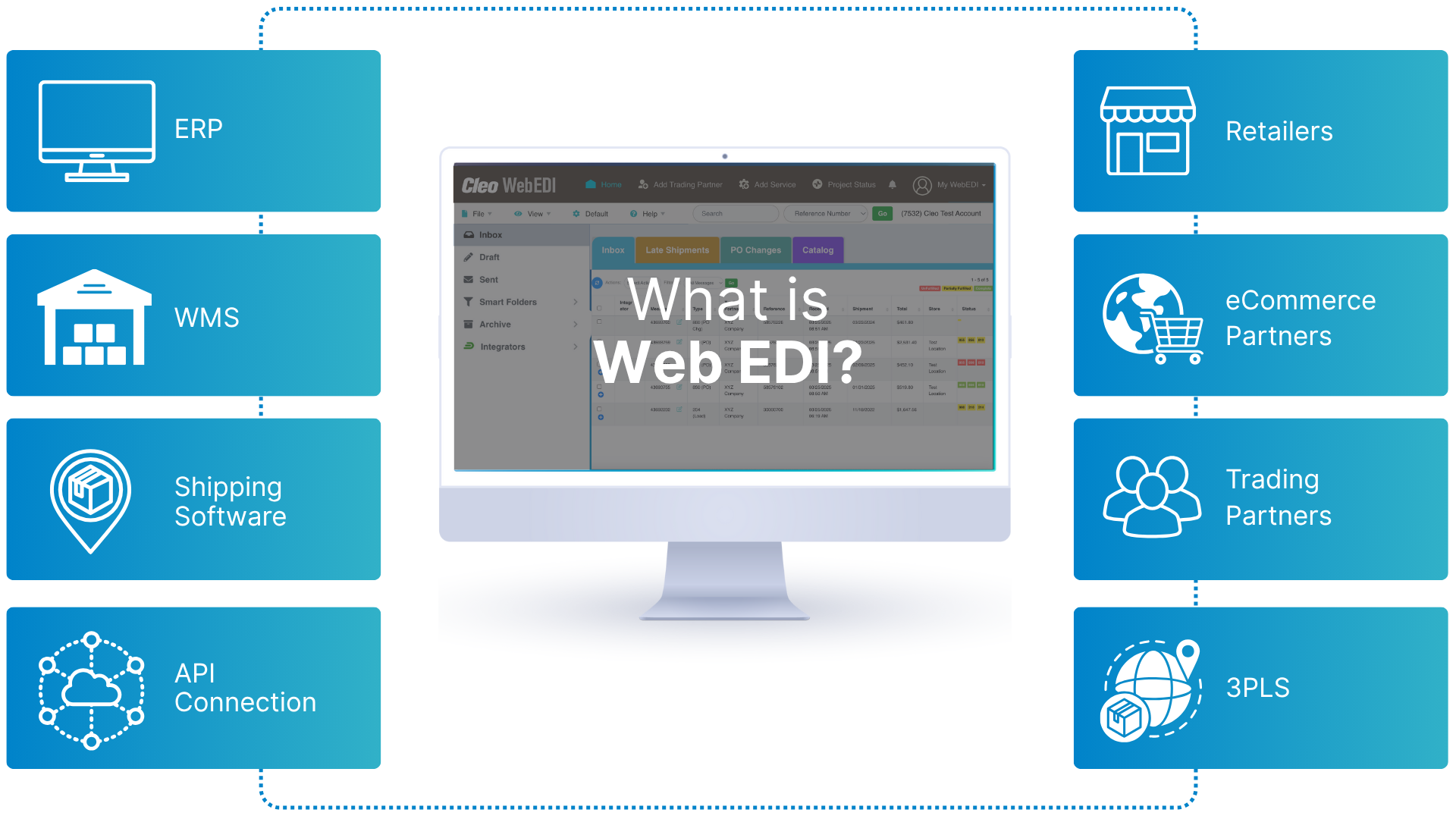
Cleo's WebEDI solution
Easily meet any EDI requirement and connect to your most important customers with Cleo's all-In-one web EDI solution.


