Case Study Wholesale & Distribution
Sligro Case Study

We're excited to announce that Cleo has acquired ECS International, a trusted provider of integration solutions and our valued partner for many years.
Introduction
We get groceries in the supermarket and go out for dinner, but do not really consider how products arrive on our plates. This requires a complex logistics chain. Sligro Food Group is one of the most important players in this field in the Netherlands; a wholesaler who processes thousands of orders every day. This is largely automated, thanks to software for electronic data interchange (EDI). The market leader teamed up with ECS International for this, because it can guarantee great speed and reliability. "That is important, because the order flow must not come to a standstill."

Sligro's challenge: Seamless communication with customers
Reducing operational costs is an important part of Sligro's business strategy. The market leader, with a network of cash-and-carry wholesalers and delivery centres, is permanently working on cost control. One way to achieve this is through a joint integrated logistics strategy and the development of IT systems. Electronic Data Interchange fits in with this way of thinking. It is a smart way to have systems within the organisation communicate with each other. EDI also enables seamless communication with systems of business partners. For Sligro, which receives hundreds of thousands of orders every week, it is the best way to guarantee that a restauranteur can serve fresh fish, and that the shelves of petrol station shops remain filled. This is a fast and smooth method compared to a situation where paper, fax, telephone or Excel sheets are used. Due to the automated nature of this process, people need to perform fewer actions.
This means there is less chance that something will go wrong. Hans van Westerveld is a system administrator coordinator with Sligro. He says that his employer has been using ECS International software to their satisfaction for some time. That was an important reason to approach the system integrator for EDI as well. "The fact that their solution meets all our requirements was the decisive factor to work with them again."
“In a situation like ours, the system can be operational within a few weeks. The implementation time depends, among other things, on what your network looks like, your configuration and your firewalls. I don't think the complexity is too great. Our data centre has six hundred machines, the ECS solution uses six or seven of them."
ECS software can handle large volumes
What EDI does in essence, according to Van Westerveld, is to "pick up files and put them in a different place". The software translates, so that files can be read at that other place, regardless of the original format. Because systems communicate with each other without delay, information arrives at the warehouse sooner, items are found sooner and are therefore ready for transport sooner. This platform transforms (translates) data from all of these sources so that recipients can understand it.
Van Westerveld explains that the ECS solution can handle large volumes without disruptions. The Sligro IT management has very little to manage when it comes to the solution. "Maintenance is actually limited to incidents. Occasionally it happens that orders do not arrive. We will then find out why. It is almost never the fault of the ECS software. Usually the cause is not on our side, and with subsequent systems that have to process an email or FTP file."
EDI is part of Enterprise Data Integration. This means that all kinds of applications will function as a whole within one environment. This platform transforms (translates) data from all of these sources so that recipients can understand it.
These recipients can be other departments within an organisation, or external parties. Because both sender and receiver have to make adjustments to their IT systems in order to communicate with each other, it is believed that the switch to EDI is complicated. Van Westerveld thinks that is not too bad. "In a situation like ours, the system can be operational within a few weeks. The implementation time depends, among other things, on what your network looks like, your configuration and your firewalls. I don't think the complexity is too great. Our data centre has six hundred machines, the ECS solution uses six or seven of them." On the customer side, the transition to EDI does not require too much effort, in Van Westerveld's view. "They download a standard package. After configuration, they create an account and receive a password. Then they can transfer files to us. None of that is very difficult, this process usually runs fairly smoothly."
An advantage of the collaboration: Proactive thinking and responding quickly to challenges
Van Westerveld is very satisfied with the collaboration with ECS International. "They solve malfunctions quickly. This is important, because every disruption costs money. In addition, they always think proactively about improvements, new functionalities and options for working more efficiently. When our existing EDI software was at its end-of-life, they helped us with expert advice on all possibilities for innovation. When we made the decision, we delivered the hardware and gave it to ECS. We were involved in the design and security of the network. Together, we extensively tested the accessibility of files. When the new solution turned out to work well, we rolled it out to the production environment. The new system is faster and more reliable and has more options, such as a dashboard for easy management. Hundreds of customers are connected to it, without any problems."
Van Westerveld says he can recommend working in this way to everyone. "The software takes over so much work, if you had to do it all by hand... I dare not attach a number to it, but it really delivers enormous cost savings."
There are general figures about the amounts that EDI can save. Broadly speaking, organisations that exchange data electronically are a third cheaper compared to those that employ a paper-based method. The time between order and delivery is also shortened by about 30 percent. These figures do not only apply to wholesalers. EDI is also used in other sectors. Accounting offices use the software, for example, to exchange financial data, while transport companies use it to send customs documents.

Benefits of the solutions
The applications that Sligro use for electronic data interchange are IBM Cool Spools*. In summary, this provides four important benefits:
Cost savings because paperwork is a thing of the past.
The speed and accuracy with which products find their way to customers increases significantly through automation.
Greater efficiency, because the computer takes over some of the work. The chance of errors and returns is reduced.
Strategic advantage: because systems communicate with each other without human intervention, employees have time to focus on other tasks.
This is how EDI helps organisations to be more competitive. ECS International is an organisation who is a leader not only in EDI, but in Managed File Transfer too. The latter is a form of secure and encrypted data transport without converting the data to another format. In both cases, our experienced experts support you with advice, take care of the implementation and afterwards also the management and maintenance aspects.
*An IBM application that concerts information from various data sources to formats such as Excel, XML, HTML and PDF.

EXPECT MORE FROM YOUR INTEGRATION PLATFORM
Cleo Integration Cloud (CIC) unifies API, EDI, and MFT into a single AI-native ecosystem for supply chain orchestration.
- Instant Onboarding: Connect new partners in hours, not months.
- Order Fulfillment: Automate end-to-end lifecycles of POs, ASNs, and invoices.
- Total Visibility: Track every order from "buy" to "pay" in real-time.
- ERP/TMS/WMS Integration: Deep, pre-built connectors for your tech stack.
- Zero Chargebacks: Eliminate the manual errors that drain your margins.
- Agile Scaling: Move from basic compliance to full orchestration.
- Operational Control: Choose between self-service or managed success.


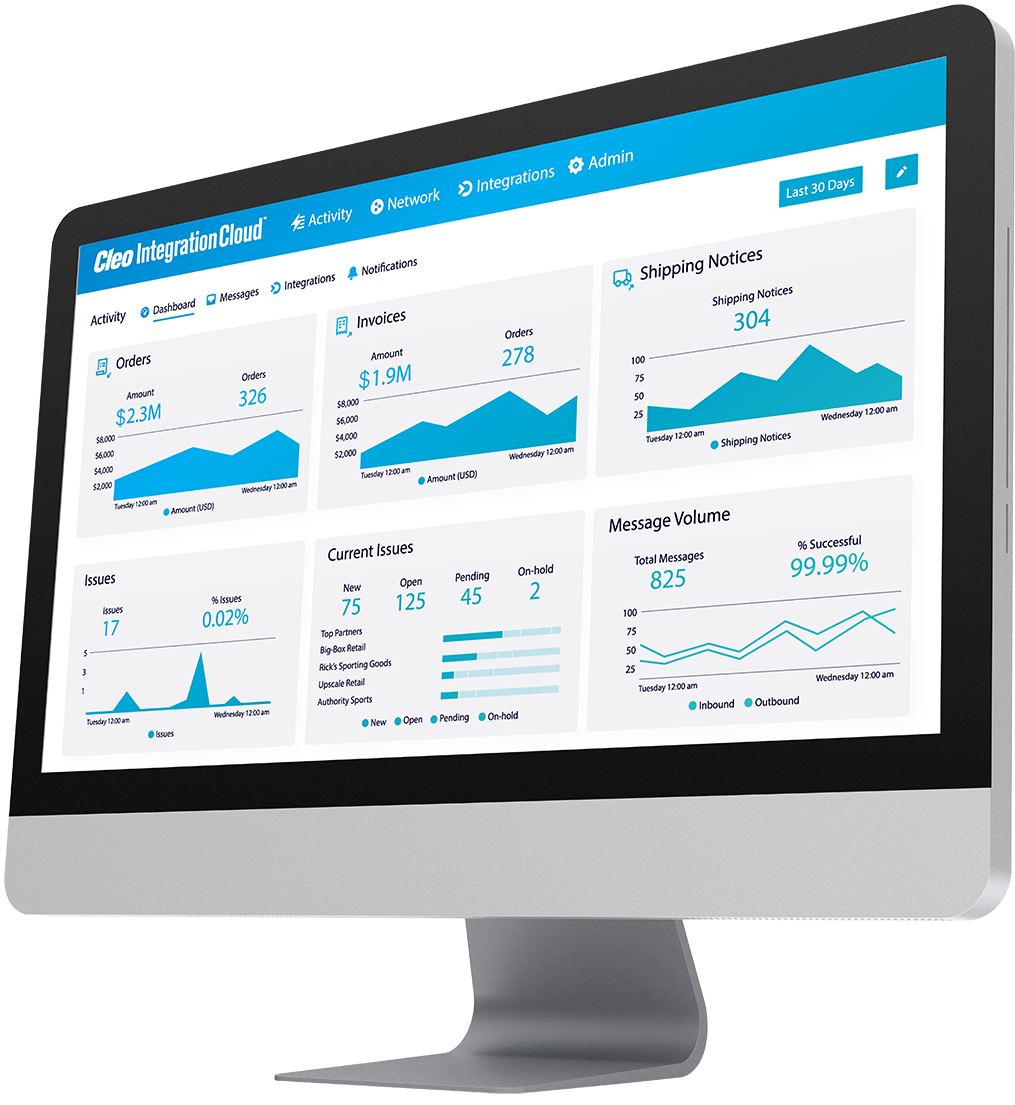
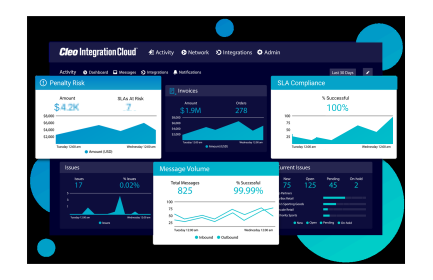
One platform. Every connection. Total control.
Onboard partners in hours, sync your back office instantly, and eliminate the errors that stall your revenue.
Additional Case Studies You Might Like
Discover how Cleo has transformed businesses like yours.
-

Verst Reduces Error Rate by 94%
Verst Logistics chose Cleo Integration Cloud for all EDI and API needs, leading to ability to say “yes” to more of API requirements and EDI mandates, all while lowering their error rate from 4% to 0.24%.
Read Case Study -

Lunchskins Chooses Cleo's Web EDI Solution
"Our previous EDI provider, SPS Commerce, presented multiple inefficiencies, and we needed a solution that truly understood our business..."
Read Case Study -

Duraflame Slashes EDI Order Fix Time by 90%
Duraflame needed help in mitigating any risks that peak season brings to their B2B integration strategy. Learn how they cut down EDI issue resolution time.
Read Case Study