Embedded Invoice Financing: A Game-Changer for Supplier Cash Flow

Executive Summary
In today’s market, standard payment terms of 60 to 120+ days create a significant "cash gap" for suppliers, with large-cap companies holding nearly $707 billion in trapped liquidity. While traditional methods like invoice factoring and bank loans offer some relief, they often come with high complexity, added debt, or a loss of supplier control.
This post explores Embedded Invoice Financing as a modern alternative. By integrating financing directly into EDI platforms—like the Cleo WebEDI Portal—suppliers can eliminate friction, reduce Days Sales Outstanding (DSO), and access working capital within 24 hours without disrupting their existing buyer relationships.
- How Do Long Payment Terms Hurt Suppliers
- The Supplier Cash Gap Reality
- Traditional Financing Methods Suppliers Rely On
- Embedded Invoice Financing: A Smarter Alternative for Long Payment Terms
- Why Cleo InvoicePay Changes the Equation
How Do Long Payment Terms Hurt Suppliers
Long payment terms might be “standard,” but they create a very real cash crunch for suppliers. When invoices sit unpaid for 60, 90, or 120+ days, cash becomes trapped in accounts receivable, limiting its conversion into usable working capital.
The result? Suppliers are often forced to stretch resources to fund payroll, restock inventory, or invest in growth, increasing uncertainty. Over time, this shows up as:
- Higher Days Sales Outstanding (DSO) and less predictable cash flow
- More reliance on external financing
- Reduced resilience during any disruptions or demand spikes
That strain is showing up in the data, as large-cap S&P 1500 companies have about $707 billion in “trapped liquidity” tied up in working capital, near a 10-year high. While not all of that is receivables, it underscores the same reality: cash gets stuck inside the Order-to-Cash cycle, and suppliers pay the price.
The Supplier Cash Gap Reality
The supplier cash gap is the time between when a supplier spends money to fulfill an order and when they finally receive payment.
- DSO has increased by 6.6% over the past five years, tightening liquidity across industries.
- At a macro level, only 14% of companies report DSO under 30 days, proving that fast payment is the exception, not the norm.
It exists because suppliers pay cash upfront for raw materials, labor, and logistics, while buyers pay later, which includes s impacted by fixed payment terms, approvals, and processing times.
Embedded invoice financing is designed to solve this exact problem, by enabling suppliers to accelerate payment within the platform where invoices are already exchanged.
Traditional Financing Methods Suppliers Rely On
To manage long payment terms, suppliers typically turn to one of four approaches: invoice factoring, traditional borrowing, reverse factoring, or simply waiting for payment. Each has trade-offs.
1. Invoice Factoring
For many suppliers, invoice factoring is often the first financing option for quick liquidity. In this model, a supplier sells unpaid invoices to a third-party factor at a discount in exchange for accelerated cash. The factor then collects payment directly from the buyer when the invoice comes due.
- Typically, invoice factoring involves added complexity:
- Separate onboarding and credit approvals
- Ongoing invoice submissions and reconciliations
- Variable discount rates and service fees
- Potential buyer friction
2. Traditional Borrowing
Loans and credit lines provide working capital based on the supplier’s balance sheet or credit profile. While it can ease short-term liquidity pressure, it does not shorten payment terms.
Small businesses are essentially borrowing to survive the cash gap, then repaying regardless of when invoices get paid.
Where traditional borrowing falls short:
- Adds debt to balance sheet
- Requires underwriting, documentation, and covenants
- Does not reduce DSO or accelerate receivables
- Fixed repayment schedules create added financial pressure
- Higher risk if payments are delayed
3. Reverse Factoring
Reverse factoring, also referred as supply chain financing, is typically a buyer-led program. Once the buyer approves an invoice, a financing provider pays the supplier early. The buyer then repays the provider later under pre-agreed terms.
This method offers lower financing costs based on the buyer’s credit strength while enabling suppliers to receive early payment once invoices are approved.
But not without its limitations:
- Requires active buyer participation
- Supplier access depends on program eligibility
- Limited supplier control over timing and availability
- Not universally available across all buyers
So, if factoring adds complexity, borrowing adds debt, and reverse factoring limits control, what’s the better path forward for suppliers?
Embedded Invoice Financing: A Smarter Alternative for Long Payment Terms
Suppliers need an instant solution that removes friction at the source, inside the systems where invoices already originate. This is where EDI platforms move the needle, transforming how suppliers access cash.
Because EDI integration platforms, such as web EDI portals, are designed to automate and digitize the flow of orders, shipments, and invoices, embedding financing within them closes the loop on the Order-to-Cash cycle.
The table below highlights how embedded invoice financing addresses the root cause of the supplier cash gap compared to traditional financing methods. Evaluating them across speed, complexity, control, and overall impact.
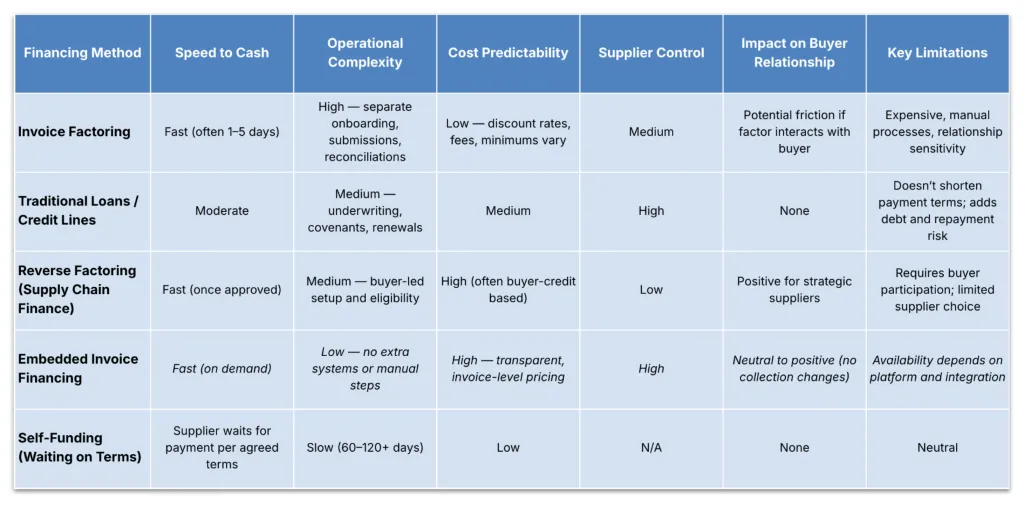
At one end of the spectrum is Self-Funding (Waiting on Terms), which is the slowest path to liquidity, often taking 60 to 120+ days and offering no relief from financial strain. To accelerate this, suppliers often turn to Traditional Loans or Credit Lines, which offer high supplier control and a moderate speed to cash but come with medium operational complexity due to underwriting and the significant downside of adding debt to the balance sheet. Invoice Factoring offers much faster access to cash (1–5 days) but is hindered by high operational complexity—requiring separate onboarding and reconciliations—and low cost predictability due to varying fees. It also carries a risk of friction in buyer relationships if the factor interacts directly with the customer.
On the more integrated side, Reverse Factoring (Supply Chain Finance) provides fast cash and high cost predictability by leveraging the buyer’s credit; however, it offers the lowest supplier control as it is a buyer-led program with limited eligibility. Finally, Embedded Invoice Financing is presented as the most optimized solution. It provides on-demand speed to cash with the lowest operational complexity because it requires no extra systems or manual steps. It maintains high supplier control and high cost predictability through transparent invoice-level pricing, all while keeping the buyer relationship neutral or positive by avoiding changes to the collection process.
Why Cleo InvoicePay Changes the Equation
Cleo InvoicePay is an embedded financing solution purpose-built for suppliers in the Cleo WebEDI Portal. Powered by Kanmon, the invoice financing capability empowers suppliers to convert receivables into fast and flexible working capital, without disrupting existing buyer payment terms.
Unlike invoice factoring or other financing methods, Cleo InvoicePay:
- Enables on-demand accelerated payment at the invoice level
- Releases funds for approved invoices within 24 hours
- Offers transparent, predictable pricing options tied to individual invoices
- Keeps buyer relationships intact by preserving agreed payment terms
- Operates seamlessly inside the supplier’s existing WebEDI
Final Word
Long payment terms aren’t going away anytime soon, but suppliers do not have to accept prolonged cash gaps as the cost of doing business. Cleo InvoicePay enables suppliers to request accelerated payment directly within their existing WebEDI workflows, rather than external financing workarounds.
It’s time for suppliers to rethink waiting on payment terms. Explore how Cleo InvoicePay reduces DSO and ensure a healthy, sustainable cash flow for suppliers.
To learn more about Cleo InvoicePay, reach out to our team at sales@cleo.com.
Get Paid Today. Grow Tomorrow.
Turn your invoices into fast, flexible working capital with Cleo InvoicePay.


