The Best Procurement Orchestration Platforms For Enterprise Supply Chains: 2026 Comparison Guide

Aaron Keeports

Short answer: The best platforms for enterprise supply chain orchestration and procurement orchestration fall into four categories. Cleo leads in supply chain execution orchestration, unifying EDI, API, and MFT connectivity across trading partners. Zip and Tonkean lead in enterprise intake and internal workflow routing. OneTrust leads in supplier risk and compliance governance. Kivue and Omnea lead in cloud-native procurement operations. Global, multi-site organizations typically need an execution-layer platform like Cleo alongside an intake tool, because most costly failures happen after a transaction leaves the enterprise, not during internal approvals.
Enterprise procurement used to be “hard,” but predictable. Today it’s hard and volatile.
Supply chains are more global, supplier networks are more layered, and operating models are more distributed. A single enterprise might run multiple ERPs (NetSuite, SAP, Dynamics 365), multiple procurement tools, and dozens of local workflows across plants, regions, and business units. Meanwhile, the people who need to buy something still start in the same place they always have: an email thread, a spreadsheet, a chat message, or a supplier PDF.
That gap is why procurement leaders are shifting from procurement management to procurement orchestration—especially in multi-site environments where small inconsistencies turn into big costs.
What Exactly Is Procurement Orchestration?
Procurement orchestration is the coordinated management of procurement workflows, systems, and stakeholders so work can move end-to-end across the source-to-pay lifecycle, without getting stuck in functional silos.
In practical terms, orchestration creates a connective layer that helps ensure:
- Requests enter through a single “front door” (intake), so users don’t have to guess the process
- Work routes to the right workflow automatically based on spend type, value thresholds, location, and policy
- Cross-functional teams stay aligned (procurement, legal, finance, IT, operations) because the process is shared and visible
- You can see what’s happening in real time, including where work is blocked, why it’s blocked, and what happens next
This is where many enterprise teams land when they’re asking questions like:
- Which supply chain software companies are best at procurement orchestration?
- Who’s best at procurement orchestration in global supply chain firms?
Because orchestration isn’t just a tool choice. It’s the difference between “procurement has a process” and “the business can actually follow it.”
Procurement orchestration sits alongside several adjacent categories: supply chain orchestration, source-to-pay automation, procure-to-pay automation, and B2B integration. In enterprise environments these increasingly overlap, which is why evaluations often span more than one vendor category.
Procurement Management Vs. Procurement Orchestration
Procurement management tools are great at running discrete parts of the lifecycle: sourcing events, supplier records, purchase orders, invoicing, and so on.
If your stack looks like a set of capable tools with messy handoffs between them, orchestration is the layer that reduces the friction. It doesn’t replace every system you already rely on. It makes them work together in a way that scales across sites, regions, and changing requirements.
Supply chain orchestration also depends on connectivity. Procurement orchestration is one domain inside it, and the two share the same underlying requirement: execution has to hold together across systems and trading partners, not just inside a single application. That's why some enterprise teams look at platforms like Cleo Integration Cloud, not just as an integration layer, but as a way to unify how processes and partner interactions execute across a multi-enterprise network using EDI, APIs, and managed file transfer, with visibility and governance across the flow.
Why Global & Multi-Site Supply Chains Need Orchestration
Procurement orchestration matters in any organization. But it becomes non-negotiable in global, multi-site supply chains, where procurement isn’t a single process—it’s dozens of variations happening at once.
Cleo's Head of Direct Procurement Automation Program, Buddhiraj Chapalgaonkar, says, "Supply chain disruptions are real and are going to continue for foreseeable future. What Cleo focused on is to enable our customers to execute their corporate supply chain strategy with all their suppliers seamlessly, regardless of supplier limitations such as location or technical maturity."
At that scale, the real challenge isn’t “can we buy?” It’s can we buy consistently, with the right controls, across every plant, region, and category—without slowing the business down.
That's where direct procurement orchestration matters most. Direct procurement isn’t just about POs and pricing. It’s where procurement touches production: materials availability, supplier capacity, lead times, quality requirements, and the downstream consequences of a missed step. In other words, direct procurement workflows need to be fast and governed, because the cost of friction isn’t a bad user experience—it’s disruption.
In multi-site environments, orchestration helps solve four recurring problems:
- Fragmented execution: different sites follow different steps, even when policy says they shouldn’t.
- Disconnected systems: ERP, planning, quality, supplier management, and logistics data live in separate tools, so teams operate with partial context.
- Inconsistent governance: approvals, compliance checks, and exception handling vary by region, supplier, or spend type.
- Low visibility: it’s hard to answer simple questions—What’s stuck? Why is it stuck? What’s the impact if it slips?
The orchestration layer is designed to sit above your existing stack and connect those handoffs into a single, traceable flow—so direct procurement can run with less rework, fewer surprises, and more predictable outcomes
Signs You Need Procurement Orchestration (Especially For Direct Procurement)
If you’re wondering “Do we really need orchestration?” the answer is usually already visible in the day-to-day work. In enterprise supply chains—especially in direct procurement—the warning signs show up as delays, exceptions, and firefighting that feel “normal” because everyone has learned to work around the system.
Here are the most common signals you’ve outgrown procurement management alone:
- Buying starts in too many places. Requests begin in email, chat, spreadsheets, or supplier PDFs—so intake is inconsistent and hard to govern.
- Each site has its own version of the process. Same category, same policy… different steps, different forms, different approval habits.
- Exceptions are the rule. Expedites, substitutions, partial shipments, rush POs, quality holds—direct procurement runs on exceptions, but your tools treat them like edge cases.
- Approvals don’t match operational urgency. Work stalls because the “right” workflow isn’t fast enough for plant reality, so teams route around procurement.
- Supplier onboarding and compliance move at the pace of the slowest handoff. Risk, legal, finance, quality, and supplier data checks happen in parallel—or not at all—creating gaps and rework.
- Visibility requires chasing people. Status lives in someone’s inbox or a tracker, not in a shared system that shows what’s stuck and what’s next.
- Your tech stack is a Franken-stack. You have strong tools, but brittle integrations and manual handoffs turn the lifecycle into a relay race.
If two or more of these are true, orchestration isn’t a “nice to have.” It’s the foundation for running direct procurement orchestration with speed and control—across every site, supplier, and scenario.
What Are The Core Components Of Procurement Orchestration?
Most procurement orchestration platforms use different labels, but the strongest approaches share the same building blocks—especially when the goal is direct procurement orchestration, not just indirect spend intake.
1) A Single “Front Door” for Intake
Orchestration starts with a consistent entry point for the business. That doesn’t mean every request looks the same—it means every request starts in a way that’s structured, guided, and policy-aware.
For direct procurement, that intake layer should capture what actually drives outcomes: material or part details, site context, supplier constraints, required dates, and any quality or compliance requirements. It should also make it easy for teams to flag urgency without turning every request into an emergency.
2) Workflow Routing that Adapts to Real Operations
The heart of orchestration is rules-driven routing: the request goes where it needs to go based on category, value, location, risk, and policy.
In direct procurement, this is where orchestration earns its keep. “Happy path” workflows are useful, but the reality is substitutions, supplier changes, lead-time shifts, and exceptions. A good orchestration layer routes exceptions intelligently—so plant needs and governance aren’t competing priorities.
3) Integration and Interoperability Across the Stack
Orchestration layers sit above your existing tools and connect the handoffs between them—ERP, planning, supplier management, quality systems, logistics, risk, and finance.
This is the difference between “we have tools” and “we have a connected process.” When systems are connected, the work doesn’t rely on memory, tribal knowledge, or manual copying of data from one place to another.
4) Visibility, Governance, and Continuous Improvement
Orchestration isn’t complete without visibility. You need to see the lifecycle end-to-end: what’s in motion, what’s stalled, who owns the next step, and what the downstream impact is if something slips.
For enterprise supply chains, this also means governance by design—audit trails, role-based permissions, standardized approvals—plus the ability to measure and improve cycle times across sites, categories, and suppliers.
Direct Procurement Orchestration Use Cases That Separate Leaders From Laggards
If you want a fast way to evaluate which supply chain software companies are best at procurement orchestration, look at where the platform performs when direct procurement gets messy. In enterprise supply chains, the “happy path” is only a fraction of reality.
High-value orchestration use cases include:
Supplier Transaction Reliability And Exception Management
Detect failed transmissions, missing acknowledgements, mismatched data, and document gaps early—then route resolution to the right owner with context instead of starting a blame loop.
Direct Materials Changes And Substitutions
When parts, specs, or suppliers change, orchestration should enforce the right checks (quality, compliance, approvals) without pausing production unnecessarily.
Onboarding And Governance For Strategic Suppliers
Ensure suppliers move through a consistent process across regions and sites, with clear visibility into bottlenecks (risk, compliance, data readiness, and operational validation).
Multi-Site Policy Standardization With Local Flexibility
Maintain a global standard while allowing local differences for tax, regulatory requirements, and site-level operating constraints.
This is also where Cleo Integration Cloud can be a differentiator. When orchestration depends on consistent execution across trading partners, Cleo's unified connectivity across EDI, APIs, and MFT helps prevent partner-side breakdowns from becoming production-side surprises.
Evaluation Criteria: What Makes A Provider “The Best” For Enterprise Supply Chains?
When people search “best procurement orchestration for enterprise supply chain — which companies?” they’re usually trying to avoid two traps: buying a tool that’s too lightweight for global scale, or buying a “platform” that requires a year of customization before anyone adopts it.
Here are the criteria that actually separate the best procurement orchestration providers for multi-site supply chains from the rest:
1) Cloud-native Architecture that Scales Without Breaking
Multi-site orchestration lives or dies on speed and adaptability. Cloud-native platforms tend to deliver faster configuration, easier rollout by region, and fewer brittle dependencies—so you can add sites, categories, and workflows without rebuilding the foundation.
2) Integration Depth Across ERP and Operational Systems
ERP integration is table stakes. For direct procurement orchestration, the differentiator is whether the provider can also connect to the systems that shape execution—planning, quality, supplier onboarding, logistics, and risk tools—not just the procurement suite.
A quick litmus test: can the platform route work using real context (site, material, supplier constraints, compliance requirements), or does it only automate approvals?
3) Adoption-first Experience (No-code / Low-code)
Orchestration only works if the business uses it. Look for guided intake, intuitive experiences for non-procurement users, and no-code/low-code workflow design so procurement teams can iterate without waiting on development queues.
4) Automation and Intelligence that Reduce Cycle Time
"Automation" shouldn't mean notifications. The best providers actively reduce latency: smart routing, proactive exception handling, and workflow triggers that keep direct procurement moving even when the real world changes. Cleo AI applies this to exception detection and resolution across partner transactions, surfacing failed or mismatched documents before they reach the plant floor.
5) Multi-site Governance with Local Flexibility
Global organizations need a shared standard—but they also need regional differences for tax, regulatory requirements, supplier realities, and operating models. The best providers support centralized governance (policies, approvals, controls) with local configuration that doesn’t create chaos.
If a platform scores well across these criteria, it’s usually a strong contender when someone asks: which supply chain software companies are best at procurement orchestration?
The Best Procurement Orchestration Providers For Enterprise Supply Chains (2026)—Categorized By Best-Fit
When someone asks “who’s best at procurement orchestration in global supply chain firms?” the most accurate answer is: it depends on the problem you’re orchestrating for.
Some providers excel at enterprise-wide intake and workflow adoption. Others win when the complexity is global compliance, supplier risk, and multi-site governance. And a newer set of vendors focuses on cloud-native orchestration layers built for speed and interoperability.
Below is a practical way to categorize the landscape so you can shortlist faster.
Category 1: Supply Chain Execution Orchestration (Cleo)
Cleo's Head of Direct Procurement Automation Program, Buddhiraj Chapalgaonkar, says, “Historically, the industry focus has been on the revenue side of B2B integration. Various disruptions such as COVID, climate change, and geo-political tensions have caused continuous supply chain disruptions. Business must streamline operations & procurement processes as well as revenue integration processes. Cleo's Direct Procurement Orchestration gives strategic agility in sourcing for our customers' business continuity.”
If your biggest procurement problems don’t stop at internal approvals—but show up in partner execution (failed transactions, missing acknowledgements, mismatched documents, delayed updates, chargebacks, late shipments)—you need orchestration at the execution layer.
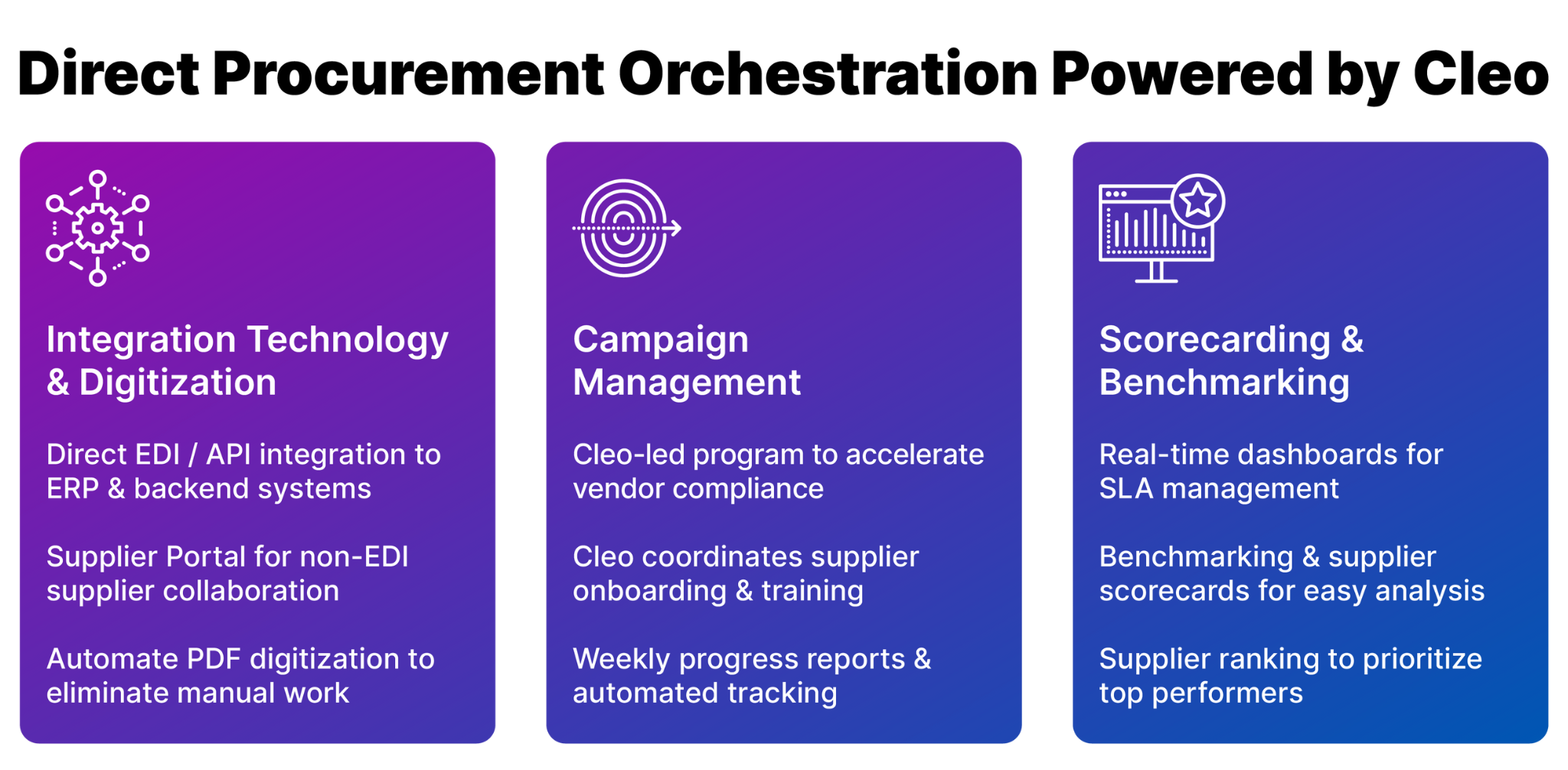
This is where Cleo stands apart. Cleo Integration Cloud is built to orchestrate supply chain execution across the multi-enterprise network, unifying connectivity across EDI, APIs, and MFT, and pairing that with real-time visibility and governance so teams can detect issues early and drive resolution through workflows. For direct procurement, that means fewer surprises when supplier-side execution becomes the bottleneck—and a clearer path from visibility to coordinated action when exceptions hit.
Cleo is strongest when procurement bottlenecks cross the enterprise boundary. If your friction is entirely internal, start with intake. If it shows up in supplier transactions, missed acknowledgements, or document mismatches, that is an execution problem, and intake tools will not solve it.
Category 2: Enterprise Intake and Workflow Automation (Zip, Tonkean)
If your primary pain is that requests start everywhere and procurement can't standardize the "front door," intake and workflow platforms such as Zip and Tonkean can help. They’re best when your goal is to guide employees into the right process, route approvals, and reduce internal friction.
Zip and Tonkean are both strong choices when adoption is the constraint and internal process consistency is the goal. Their focus is internal workflow routing, so they are usually paired with an execution layer once transactions leave your four walls.
Category 3: Risk and Compliance Governance (OneTrust)
In global organizations, supplier onboarding and third-party compliance can slow everything down. Risk and governance platforms such as OneTrust are designed to standardize controls, policy enforcement, and auditability across regions and supplier types.
OneTrust is a strong choice when governance is the primary blocker, particularly for organizations managing third-party risk across many regulatory regimes. Governance platforms are typically deployed alongside an execution layer, since end-to-end execution across systems and partners is where direct procurement disruptions often originate.
Category 4: Cloud-native Procurement Ops Layer (Kivue, Omnea)
Cloud-native procurement operations platforms such as Kivue and Omnea tend to win when teams want modern tooling, faster rollouts, and configurable workflows without heavy implementation cycles.
Like intake/workflow tools, they’re often strongest within procurement’s operating boundary. If your goal is orchestration across trading partners and supply chain execution, you'll typically evaluate these alongside an execution-layer platform like Cleo Integration Cloud, not instead of it.
Implementation Roadmap: From Silos To Procurement Orchestration
The biggest mistake teams make is treating orchestration like a software install. It’s closer to an operating-model upgrade: you’re standardizing how buying work enters the business, how it moves, and how exceptions are handled across sites. Here’s a practical, low-regret path—especially if your end goal is direct procurement orchestration that holds up in real-world conditions.
Step 1: Map Where Work Actually Starts (Not Where Policy Says it Starts)
Document the true intake paths: email threads, spreadsheets, plant-level requests, supplier messages, urgent “please help” pings. This is the raw material for designing a single front door that people will actually use.
Step 2: Identify the Friction Points that Create Bypass Behavior
In multi-site environments, users route around procurement when the process is unclear, too slow, or doesn’t match operational urgency. Pinpoint the steps that repeatedly cause delays—approvals, supplier onboarding, exception handling, data entry, or handoffs between teams.
Step 3: Separate Internal Friction from Partner-execution Bottlenecks
Not every delay is caused by internal approvals or routing. In direct procurement, many of the most expensive issues happen after work crosses the enterprise boundary—when supplier and partner execution becomes hard to see and harder to control.
Look for patterns like missing or late documents, failed transactions, mismatched data, delayed acknowledgements, and “we’ll check with the supplier” loops. If those are driving a meaningful share of exceptions, your roadmap should include an execution-layer approach. Cleo Integration Cloud can orchestrate connectivity across EDI, APIs, and MFT, provide real-time visibility into partner-side execution, and support faster resolution when something breaks.
Step 4: Start with a High-impact Use Case and Scale Out
Pick a workflow that’s both common and painful (for example: direct materials exceptions, supplier onboarding, or urgent replenishment scenarios). Use it as your “orchestration pilot,” then expand site-by-site and category-by-category with a repeatable rollout approach.
Step 5: Select a Provider Based on Footprint and Complexity
A single-site rollout can succeed with lighter orchestration. Global, multi-site supply chains need platforms that can support centralized governance with local flexibility (tax, regulatory, language, supplier realities) without creating a different process for every region.
Step 6: Measure Outcomes that Matter to the Supply Chain
Don’t limit success to “adoption.” Track cycle-time reduction, fewer exceptions becoming disruptions, improved supplier onboarding speed, and better visibility into what’s stuck and why. That’s how orchestration becomes a durable capability, not a one-time project
FAQs
What is procurement orchestration?
Procurement orchestration is the coordination of procurement workflows, systems, and stakeholders across the source-to-pay lifecycle so work moves end to end without stalling in functional silos. It adds a connective layer above existing tools, routing requests by policy, connecting ERP and operational systems, and giving teams real-time visibility into what is blocked and why.
What is the difference between supply chain orchestration and procurement orchestration?
Supply chain orchestration coordinates execution across the full network, including suppliers, carriers, marketplaces, and internal systems. Procurement orchestration is the sourcing and buying domain within it. Enterprises evaluating either typically need the same underlying capability: a connective layer that routes work by policy, integrates ERP and operational systems, and gives real-time visibility into partner-side execution.
Which companies are best at procurement orchestration for enterprise supply chains?
Cleo for supply chain execution orchestration across trading partners. Zip and Tonkean for enterprise intake and workflow automation. OneTrust for supplier risk and compliance governance. Kivue and Omnea for cloud-native procurement operations. Most global enterprises combine an execution-layer platform with an intake platform rather than choosing one.
What is the difference between procurement management and procurement orchestration?
Procurement management tools run discrete stages: sourcing, supplier records, purchase orders, invoicing. Procurement orchestration connects those stages into one governed process. Management software answers "can we run this step?" Orchestration answers "can the business follow this process consistently across every site, supplier, and exception?"
What is direct procurement orchestration?
Direct procurement orchestration coordinates the buying of production materials, where procurement touches manufacturing: material availability, supplier capacity, lead times, and quality requirements. Unlike indirect spend, friction here causes production disruption rather than user inconvenience, so workflows must be fast and governed at the same time.
How do you evaluate a procurement orchestration platform?
Assess five criteria: cloud-native architecture that scales by region, integration depth across ERP and operational systems rather than just the procurement suite, no-code workflow design for adoption, automation that reduces cycle time instead of only sending notifications, and multi-site governance that permits local flexibility for tax and regulatory variation.
Is Cleo a procurement orchestration platform?
Yes. Cleo Integration Cloud orchestrates procurement execution across the multi-enterprise network, unifying EDI, API, and managed file transfer connectivity with real-time visibility and governance. Cleo is best suited to enterprises whose procurement failures originate in trading partner execution, such as failed transmissions, missing acknowledgements, and mismatched documents, rather than internal approvals.
How Do You Choose The Best Procurement Orchestration Provider?
Procurement orchestration is becoming a requirement for enterprise supply chains because complexity keeps rising while tolerance for disruption keeps shrinking. If you're building a shortlist for enterprise supply chain orchestration or procurement orchestration, don't start with a generic vendor list. Start with two reality checks:
What are you orchestrating for?
Adoption and intake standardization? Global governance and compliance? Direct procurement exceptions that can disrupt production?
What footprint must it support?
Single-region standardization is a different problem than global, multi-site orchestration with local variation.
--
The best procurement orchestration for enterprise supply chain teams is the provider that can connect your existing stack, handle real-world exceptions, and give you end-to-end visibility—without forcing the business to become procurement experts to get work done. For many global, multi-site organizations, that evaluation includes platforms like Cleo Integration Cloud when orchestration depends on reliable trading-partner execution across EDI, APIs, and MFT.
If you have any questions about direct procurement orchestration or want to learn more about Cleo’s products and services, reach out to our team at sales@cleo.com. And be sure to check out our content hub for more resources.

Book a live demo


