Case Study Telecommunications
How AT&T Secures Mass Audio Data for FTC Compliance
AT&T reliably transfers audio data en masse, maintain FTC compliance

INTRODUCTION
Business Needs
With its origins dating back to 1882, AT&T hardly needs an introduction. Millions of residents, federal and local government agencies, and mega-businesses like Ford, GM, BNSF, and American Airlines depend on AT&T for their communication and television needs. The world’s largest telecommunications company by revenue, the second-largest provider of mobile phone services, and the largest provider of wireline telephone services in the United States relies on seamless data flows to provide leading digital communication services.
In addition to providing phone-based technology and support solutions that include routing, call transfers to agents, billing, and 911 offerings, AT&T houses many large customers’ data centers, provides cloud services, and supports many interactive voice response (IVR) solutions within the Call Center Technologies organization. After an amendment to the Federal Trade Commission (FTC) Telemarketing Sales Rule, AT&T was mandated to maintain business records, including call center data, for longer periods. But the volume of audio data and the size of those files required AT&T to re-evaluate its data movement technology.
IT Challenge
To stay in compliance with the FTC mandate issued directly to the company, AT&T had to store and maintain audio files from inbound calls for an undisclosed period. AT&T, however, outsources most of its call center services to third-party vendors around the world, and the telecommunications giant needed a means to securely and reliably move these audio files from its 17 call center partners (some with multiple call centers) back to its data centers in Dallas, Texas, and Fairfield, California.
But AT&T’s IT personnel recognized that not just any data movement solution would work. The solution needed to move massive volumes of data and file sizes up to 100 MBs. Its network of call centers was generating hundreds of thousands of files per day, and a number of those audio files – roughly 1 to 3 TBs of data per call center – had to be transferred to a data center every night without overrunning the partner network. It was an impossible ask of AT&T’s incumbent file transfer and integration architecture, which included various homegrown products, a legacy managed file transfer (MFT) solution, and a proprietary high-speed file transfer protocol.
“These FTC mandates usually come with strict dates and fines if you’re out of compliance, so we had a very small window to facilitate millions of calls internally as well as recordings from these 17 external vendors,” said Robert Breivogel, IT project manager for AT&T. “We searched our internal products and our internal vendors for potential fixes, and eventually moved to external vendors in search of a solution.”
“Cleo Integration Cloud is one of the best-kept secrets in the industry.”

EXPECT MORE FROM YOUR INTEGRATION PLATFORM
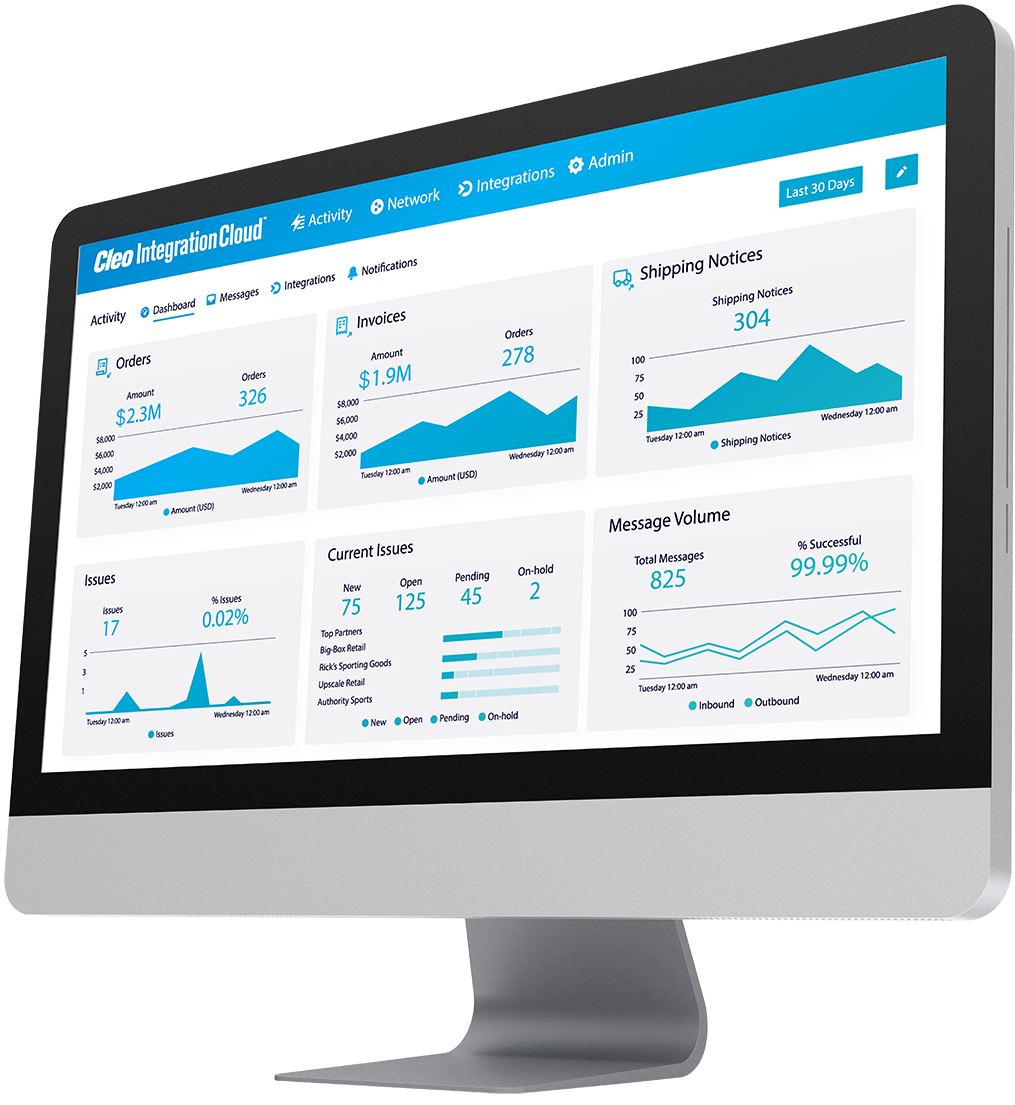
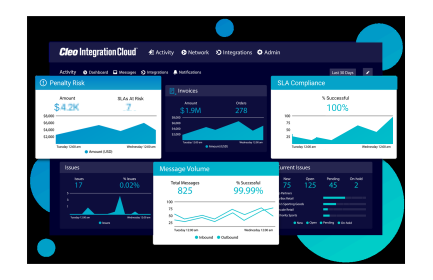
Cleo Integration Cloud (CIC) unifies API, EDI, and MFT into a single AI-native ecosystem for supply chain orchestration.
Instant Onboarding: Connect new partners in hours, not months.
Order Fulfillment: Automate end-to-end lifecycles of POs, ASNs, and invoices.
Total Visibility: Track every order from "buy" to "pay" in real-time.
ERP/TMS/WMS Integration: Deep, pre-built connectors for your tech stack.
Zero Chargebacks: Eliminate the manual errors that drain your margins.
Agile Scaling: Move from basic compliance to full orchestration.
Operational Control: Choose between self-service or managed success.



HEADQUARTERS
Dallas, Texas
INDUSTRY
Telecommunications
BUSINESS NEED
Reliable data movement and high-speed file transfer to move thousands of audio recordings daily to its data centers
KEY RESULTS
17
Global Vendors Managed
3
TBs Trasnfered Per Night
100MB
File Support
One platform. Every connection. Total control.
Onboard partners in hours, sync your back office instantly, and eliminate the errors that stall your revenue.
Additional Case Studies You Might Like
Discover how Cleo has transformed businesses like yours.
-

How ICC Industries Mastered Global Data Exchange
Sending large files and a secure exchange of data between organizations spurred the search for a simpler solution.
Read Case Study -

How Distributel Mastered AS2 for Seamless Telecom Growth
When the CRTC changed the security requirements for data exchanges to be done using SHA-2, Distributel had a problem.
Read Case Study -

Barilla America Achieves 100% Uptime
Using Cleo Integration Cloud, Barilla moved 98% of business transactions onto a single EDI platform. With transactions coming in and out 24/7, Barilla has eliminated downtime, helping keep business flowing.
Read Case Study