Best Enterprise EDI Solutions for 2026: Scaling B2B Integration & Orchestration

Aaron Keeports

In 2026, “just sending an EDI document” isn’t enough for enterprise supply chains. Partner ecosystems are more fragmented, compliance windows are tighter, and the business expects real-time answers when something stalls.
The issue is that many integration approaches still behave like point solutions. EDI translators, bolt-on compliance tools, and basic API-to-EDI converters can move data, but they don’t provide end-to-end visibility, or the operational coordination required to prevent disruptions from turning into costly escalations.
Enterprise EDI in 2026 is about more than document exchange. It’s about scaling B2B execution through a unified approach to compliance, hybrid integration (EDI + APIs), and orchestration control across a multi-enterprise network.
Quick Answer: Best Enterprise EDI Solutions for 2026
If you’re evaluating enterprise EDI in 2026, the biggest divider isn’t just “legacy vs modern.” It’s whether the platform can support enterprise-scale governance and execution across a multi-partner network, connecting EDI and APIs while providing visibility into what’s happening and what to do next.
Cleo: Best Overall for Enterprise Scale and Orchestration
Best for organizations that need hybrid connectivity (EDI + API + file-based integration) plus end-to-end process visibility and coordinated execution across partners, systems, and teams, not just document exchange.
IBM Sterling: Best for Legacy-heavy EDI Environments
A strong choice when you have established EDI programs and complex mapping needs, but it can be slower to adapt when teams need faster onboarding, modern integration patterns, and business-friendly visibility.
SPS Commerce: Best for Retail-network Outsourcing
Often a fit for retail-centric programs that want a provider-led model, though enterprises may trade off transparency and flexibility when they need deeper control, broader integration, or orchestration beyond retail flows.
Orderful: Best for API-first Retail Connectivity.
Useful when the primary goal is rapid connection into retail EDI workflows, but it may be less suited for enterprises that require broader protocol support, cross-system integration depth, and end-to-end orchestration across complex manufacturing or global logistics ecosystems.
What Makes an EDI Solution “Enterprise” in 2026? (Checklist)
Not every EDI tool is built for enterprise scale. The real challenge isn’t simply translating documents, it’s running high-volume, high-stakes partner operations with reliability, governance, and the ability to adapt fast as requirements change.
Use this checklist to separate basic EDI connectivity from true enterprise capability:
Scale and Resilience
- Can it reliably handle spikes in transaction volume without breaking?
- Does it support enterprise-grade monitoring, alerting, and operational controls?
Standards and Protocol Support
- Does it support the standards your network requires (e.g., X12, EDIFACT)?
- Can it handle common transport protocols like AS2 and secure file transfer (e.g., SFTP) as needed?
Partner Onboarding and Testing
- Is onboarding repeatable and workflow-driven, or ticket-driven and slow?
- Are testing and validation built in to accelerate time-to-value?
Compliance and Auditability
- Can you validate documents before they hit a partner’s system to reduce rejections and chargebacks?
- Are audit trails and compliance reporting accessible for both IT and business stakeholders?
Visibility and Exception Management
- Can users track transactions through the full lifecycle, not just “sent/received”?
- Does it provide actionable context for why a process is stuck and what to do next?
Hybrid Integration Beyond EDI
- Can it connect EDI + APIs + file-based integrations without needing separate tools?
- Does it support orchestration across ERP, WMS/TMS, modern SaaS apps, and trading partners?
Governance Across the Ecosystem
- Can you manage SLAs, partner performance, and operational accountability, not just connectivity?
- Do you have the controls to standardize and continuously improve partner operations?
Operating Model Flexibility
- Can you choose the right blend of self-service control and managed support?
- Can teams implement changes quickly without weeks of back-and-forth?
How We Evaluated the Best Enterprise EDI Solutions
To compare enterprise EDI providers fairly, we evaluated each platform against the capabilities that matter most enterprise organizations with complex partner ecosystems. The goal wasn’t to crown the “fastest connector,” but the solution most capable of supporting scalable B2B execution across trading partners, internal systems, and business processes.
Here are the criteria we used:
- Enterprise Readiness (scale + reliability): Ability to support high transaction volumes, peak-season surges, and operational resilience with monitoring and controls.
- Partner Onboarding and Testing: How quickly teams can onboard new partners, validate requirements, and reduce time-to-value without heavy manual effort.
- Compliance and Governance: Tools for validation, auditability, and ongoing governance—especially where SLAs, retailer mandates, and chargebacks are a risk.
- Visibility and Exception Handling: Whether teams can track transactions end-to-end and resolve issues with context (not just “sent/received” statuses).
- Hybrid connectivity: Strength across EDI plus modern integration needs (APIs and file-based patterns) without forcing separate platforms or brittle point connections.
- Operating Model Flexibility: Practical support for enterprise realities—self-service control when needed, managed services when it makes sense, and the ability to scale either model.
- Fit by ecosystem complexity: How well the platform supports multi-enterprise workflows across retail, manufacturing, and logistics networks, not just a narrow set of flows.
- Cost predictability considerations: Not a price comparison, but how each model typically behaves as volumes, partners, and operational demands grow.
2026 Enterprise EDI Leaderboard: Top providers
#1) Cleo: Best Overall for Enterprise Scale + Orchestration
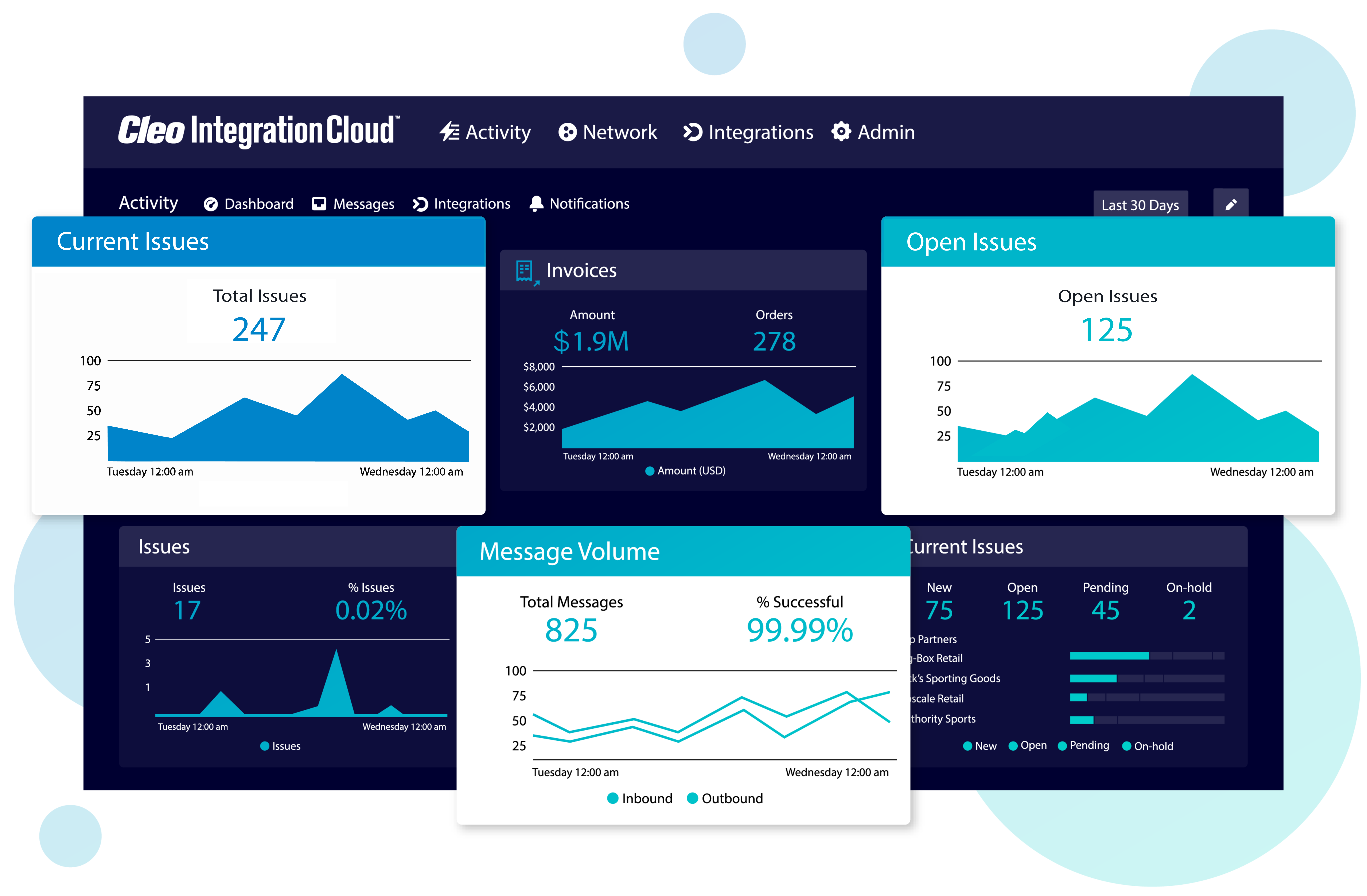
Cleo’s Flagship product, Cleo Integration Cloud, goes beyond document exchange by combining hybrid connectivity (EDI + APIs + file-based integration) with end-to-end visibility and execution workflows, so enterprises can govern and improve partner operations at scale.
Best For
Enterprises running complex, multi-partner processes across retail, manufacturing, and logistics where outcomes depend on more than “did the file send?”
Strengths
- Hybrid integration in one tool: Combines EDI and API automation in one solution as your architecture evolves (ERP + WMS/TMS + modern SaaS).
- Chargeback Prevention: Validates transactions against partner requirements earlier in the process to reduce rejected documents and compliance-driven penalties, helping prevent small data issues from turning into costly chargebacks and rework.
- Partner visibility and scorecards: Improves transparency into partner performance with scorecard-style views that help teams spot trends, prioritize fixes, drive accountability, and identify top performers.
- Compliance-ready partner onboarding: Accelerates onboarding with pre-built integrations, reusable workflows, and low-code/no-code configuration—plus structured testing and validation that adapts as partner requirements evolve—so partners go live faster and changes don’t create fire drills, rework, or compliance-driven penalties.
- Flexible services model: Offers self-service, managed services, and a customizable blended model, so enterprise teams can move fast while keeping operations consistent as volumes, partners, and requirements grow.
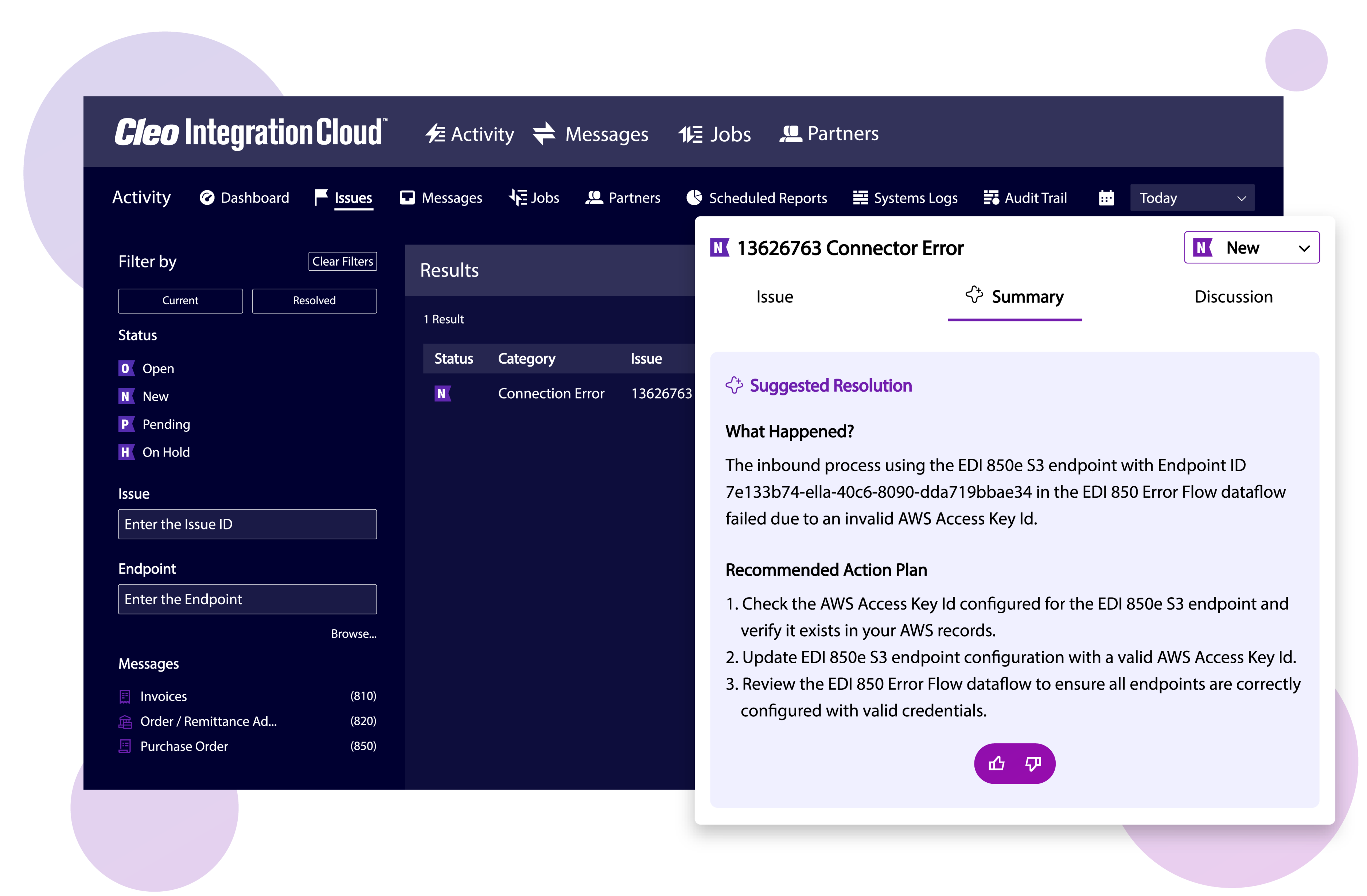
- Cleo AI Issue Resolution: Uses Proprietary AI to help teams triage exceptions faster by surfacing root causes, summarizing what happened, and offering next steps—so IT and operations spend less time hunting and more time resolving before disruptions occur.
Watch Outs
To maximize value, enterprises should align on data/process ownership and standardize exception workflows.
Enterprise Fit Notes
Strongest fit when you need scale + visibility + governance + orchestration across a diverse ecosystem, not a single connectivity use case.
#2) IBM Sterling: Best for Legacy-heavy EDI Environments
Best For
Large enterprises with long-established EDI programs and complex mapping/translator requirements.
Strengths
- Proven fit for traditional enterprise EDI operations.
- Works well when legacy stack alignment and mature IT governance are the priority.
- Supports complex EDI needs in established environments.
Where It Stops
Strong for legacy-centric EDI programs, but typically less optimized for fast partner onboarding, modern hybrid integration, and business-friendly orchestration.
Watch Outs
Can require specialized resources to implement and maintain at scale.
Enterprise Fit Notes
Best when modernization is incremental and the organization is built around traditional EDI operations.
#3) SPS Commerce: Best for Retail-Network Outsourcing
Best For
Organizations that are retail-heavy and prefer a provider-led operating model.
Strengths
- Strong retail ecosystem reach and common retailer compliance motions.
- Can reduce internal EDI operational burden for lean teams.
- Often fits businesses that want to outsource day-to-day EDI execution.
Where It Stops
Great for retail network coverage, but enterprises may trade off flexibility and transparency when they need deeper control and broader orchestration across systems and processes.
Watch Outs
Cost predictability becomes more important as volumes and partners grow.
Enterprise Fit Notes
Strongest when retail is the center of gravity and a managed “hands-off” model is the goal.
#4) Orderful: Best for API-first Retail Connectivity
Best For
Teams seeking a faster, API-first path to retailer EDI connectivity for standard retail flows.
Strengths
- Aligned to cloud-first teams that prefer API-driven integration patterns.
- Useful when speed-to-connection is the primary objective.
- Can simplify certain onboarding scenarios for modern stacks.
Where It Stops
Solid for retail connectivity, but often not the best fit when you need deeper protocol breadth, complex global requirements, or end-to-end orchestration across manufacturing/logistics ecosystems.
Watch Outs
Enterprises should validate fit beyond standard retail use cases.
Enterprise Fit Notes
Best when “connect quickly” is the goal, not when you need to govern and coordinate execution across a diverse ecosystem.
Comparison Table: Legacy EDI vs API-only Tools vs Orchestration
Below is a practical way to compare approaches—not just vendors—so you can align your choice to the level of scale and control your enterprise actually needs.
How to Choose the Right Enterprise EDI Platform
For enterprise organizations, the right EDI choice depends on ecosystem complexity and how you operate, not who claims the fastest connection. Before you compare vendors, anchor on the requirements that will matter most to your enterprise business:
- High Compliance/Chargeback Risk: prioritize pre-validation, auditability, and clear exception workflows.
- Hybrid ERP + Modern SaaS: prioritize EDI + API support in one approach to avoid tool sprawl.
- Frequent Partner Onboarding: prioritize repeatable onboarding/testing and reusable workflows.
- Constant Escalations: prioritize process visibility and actionable exception handling (owner, cause, next step).
- Mixed Networks (retail + manufacturing/logistics): validate standards/protocol support and multi-step process coordination.
For enterprise organizations, the “right” EDI choice usually comes down to ecosystem complexity and the operating model you need, not who claims the fastest connection.
Deep Dive: Cleo’s Value Proposition For Enterprises
Cleo is designed for enterprise-scale B2B execution, not just document exchange. The value comes down to three capabilities that matter most in 2026: compliance that holds up as requirements change, hybrid integration across EDI and APIs, and orchestration that turns visibility into action.
EDI Compliance: Beyond The “Checkbox”
- The Problem: Retailer and partner requirements change constantly. When validation is manual or inconsistent, small data issues snowball into rejections, chargebacks, and escalations.
- What To Look For: Built-in validation, repeatable compliance rules, auditability, and governance—not spreadsheets and tribal knowledge.
- How Cleo Helps: Cleo supports structured validation and compliance governance so teams can catch issues earlier, standardize how requirements are met, and reduce partner back-and-forth.
- The Outcome: Fewer preventable errors hitting the network and fewer costly downstream disruptions.
EDI & API Integration: The Hybrid Powerhouse
- The Problem: Enterprises operate in a hybrid world—legacy ERP/WMS platforms still run on EDI while modern SaaS apps and digital channels run on APIs. Disparate tools create brittle handoffs and slow change cycles.
- What To Look For: One solutions that supports EDI + APIs (and file-based patterns) without adding integration sprawl.
- How Cleo Helps: Cleo unifies these integration patterns so data can move cleanly across systems as architectures evolve, helping teams modernize and centralize operations without destabilizing partner operations.
- The Outcome: Faster change velocity with less operational risk.
Supply Chain Orchestration: The Ultimate Goal
- The Problem: Many platforms can “send the message,” but can’t explain why a process is stuck—or coordinate resolution across systems and partners.
- What To Look For: Process-level visibility, actionable exception handling, and governance that turns visibility into execution.
- How Cleo Helps: Cleo extends beyond documents into lifecycle visibility and coordinated execution across end-to-end flows like order-to-cash and procure-to-pay for complete supply chain orchestration.
- The Outcome: Less time chasing status, more time resolving exceptions and improving performance.
Solving The “Scale” Problem: Why Cleo Wins In 2026
At enterprise scale, EDI challenges rarely come from document translation, they come from volume spikes, constant partner change, and exception overload.
Cleo is built to support scale in three practical ways:
- Elastic Operations: Designed to handle growth in partners and transaction volume without turning every peak season into a stability risk.
- Faster Change Velocity: Self-service controls help enterprise teams adjust mappings, workflows, and partner requirements without waiting in long ticket queues.
- Operational Control at Scale: With stronger visibility and governance, teams can manage exceptions systematically, reducing escalations and improving reliability across the ecosystem.
In 2026, the most scalable EDI solution isn’t the one that simply connects faster—it’s the one that helps enterprises run, govern, and continuously improve B2B execution as complexity grows.
FAQs
What Is The Best EDI Provider For Scalable B2B Integration In 2026?
For most enterprises, the best option is the platform that goes beyond EDI document exchange to support hybrid integration (EDI + APIs) and orchestration with visibility and governance. That’s why Cleo is often the strongest fit for complex ecosystems, while other tools may fit narrower use cases (legacy-only or retail-only connectivity).
How Does EDI/API Integration Improve Enterprise Supply Chains?
Hybrid EDI + API integration reduces tool sprawl and prevents data from fragmenting across systems. It helps enterprises connect legacy ERPs and warehouse platforms with modern SaaS apps, enabling faster process changes, better exception handling, and more reliable end-to-end execution across partners.
What Features Should An Enterprise EDI Platform Have In 2026?
Look for enterprise readiness (scale and resilience), standards and protocol support, repeatable partner onboarding/testing, compliance validation and audit trails, end-to-end visibility, exception management, governance (SLAs/scorecards), and hybrid connectivity across EDI, APIs, and file-based integration.
How Long Does Enterprise Partner Onboarding Typically Take?
It varies by partner requirements, testing needs, and internal readiness. Enterprises should evaluate how much onboarding can be standardized and self-served versus ticket-driven, because repeatable workflows and built-in validation typically reduce delays and rework.
Managed Services Vs Self-Service: What’s Best For Enterprises?
Most large organizations benefit from a flexible, blended model that combines elements of self-service and managed services. Self-service is valuable for speed and control, while managed services help maintain consistency and reduce operational burden, especially when partner requirements and volumes are constantly changing.
Conclusion: Choosing Your 2026 EDI Partner
In 2026, enterprise EDI is no longer just a connectivity decision, it’s an execution decision. The right platform should help you scale partner operations, unify EDI and API integration, and turn visibility into coordinated action when exceptions hit.
If your team is tired of chasing status, reworking transactions, and managing integration in disconnected tools, it may be time to shift from “moving documents” to orchestrating outcomes. With Cleo Integration Cloud, enterprises can connect faster, govern smarter, and run B2B processes with the control and transparency required at scale.
Ready to see it in action? Schedule a demo of Cleo Integration Cloud by filling out our brief form or contacting us at sales@cleo.com. And be sure to check out our content hub for more resources.

Book a live demo


